The Bhutanese Leading the way.
The much-disrupted Damchu–Chukha bypass, which has remained closed after the recent 4-5th October flood, is expected to reopen by 15th November, according to the Ministry of Infrastructure and Transport (MoIT).
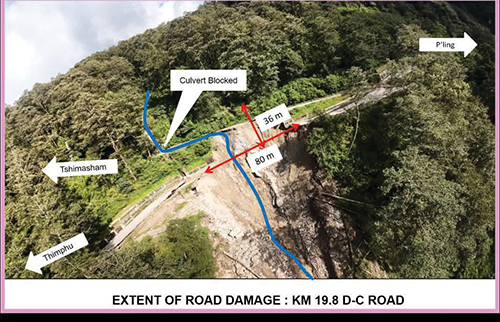
The Department of Surface Transport (DoST) under MoIT reported that although Project DANTAK promptly deployed restoration teams, traffic has been restored on all affected sections except at km 19.900 on the Damchu–Chukha road, where an 80-metre stretch was completely washed away.
According to the department, the collapse occurred after a culvert on the Tshimasham road, located just above the Damchu–Chukha section, became clogged, causing heavy water overflow across both roads and triggering a major landslide.
Due to the unstable geological strata, restoration at the site remains technically complex and challenging.
To address this, an alternate 900-metre bypass is being developed to reconnect the Tshimasham and Damchu–Chukha roads. The works involve new formation cutting, construction of retaining and drainage structures, and road surfacing.
Currently, restoration work is ongoing, with heavy machinery and technical teams deployed to expedite completion and ensure the route is reopened as soon as possible.
During the 21st Meet-the-Press session, MoIT Secretary, Karma Wangchuk, said the ministry is closely monitoring the situation and working in coordination with Project DANTAK, which is responsible for the restoration works.
He said, “We are in constant communication with DANTAK, and the ministry has been informed that the Damchu–Chukha bypass will be open to commuters by 15th November.”
The closure of the bypass has caused major inconvenience and safety concerns for travelers, who have been forced to take the narrow and twisted Tsimakha route as an alternative.
Commuters have raised concerns over the delay in restoration, citing increased travel time and high risk of accidents along the detour.
Additionally, Prime Minister, Dasho Tshering Tobgay, shared that dzongkhags have been instructed to stay on high alert and to report any new damages immediately, given the likelihood of continued rainfall and potential landslides in the coming days.
He said the Department of Surface Transport has already deployed machinery and engineering teams to clear blockages and ensure rapid road reopening in affected areas.
The recent flash floods of 4th-5th October have caused extensive damage to road networks and bridges across several districts, particularly in Chukha, Haa, Dagana, Samtse, and Sarpang.
According to the ministry, a total of 19 bridges were affected, nine completely washed away and ten partially damaged. Among those destroyed were mostly Bailey bridges, which are temporary structures, while no permanent bridges were lost in the disaster.
Four major road sections were also cut off, including the Haa–Samtse Secondary National Highway, which remains disconnected following the washing away of the Namchukhola Bailey Bridge.
Few others include Denchukha Dzongkhag Road cut off due to the washing away of Denchukha Bailey Suspension Bridge, Dzongkhag Road to Dungna and Metakha also remains cut off due to the washing away of Tomichu and Melamchu Bailey bridges, farm road to Baeyul Kinzang under Bongo Gewog and Totokgom under Bjachhog Gewog under Chukha is also cut off due to the washing away of the Bjimechu Bailey bridge.
The ministry shared that engineers from DoST are currently deployed in the site and they are clearing the nearby forest, collecting rocks to construct a temporary bridge. Accordingly, within a week or two the works will be completed.
Other temporary restoration works, such as log bridges, hume-pipe culverts, and bypass routes, are being constructed wherever feasible to restore connectivity.
The ministry estimated that the immediate restoration cost for damaged bridges and roads stands at Nu 388.50 million (mn), while an additional Nu 145 mn will be required for permanent restoration, bringing the total to Nu 533.50 mn.
A request for this amount has been submitted to the Ministry of Finance through the Disaster Restoration Fund.