The Bhutanese Leading the way.
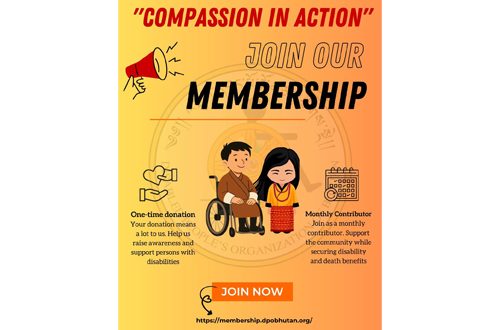
In a country that prides itself on compassion and inclusivity, the Disabled People’s Organization of Bhutan (DPOB) is calling on citizens to turn empathy into action.
The organization has launched an ambitious initiative to reach 10,000 members, inviting individuals to contribute either through a one-time donation or monthly support, aimed at improving the lives of persons with disabilities (PWDs) across Bhutan.
The initiative is not merely about increasing numbers. It seeks to build a sustainable support system where citizens become active participants in addressing the challenges faced by PWDs, ranging from limited access to services and employment opportunities to social stigma and isolation.
An estimated 15,000 persons in Bhutan live with severe disabilities, about 2.4 percent of the PWD population, many of whom are unable to care for themselves and require sustained, long-term support.
For a large number of these individuals, daily life depends heavily on caregivers, most often family members, who must balance caregiving responsibilities with their own economic and social demands.
In many cases, this creates significant financial and emotional strain on households, particularly where access to specialized services, assistive devices, and inclusive infrastructure remains limited.
Despite growing awareness around disability inclusion, gaps in consistent support systems continue to leave many persons with severe disabilities vulnerable and dependent. It is within this context that collective, community-driven support becomes increasingly urgent.
In addition, DPOB does not receive regular institutional funding and largely depends on public donations and voluntary contributions to sustain its work. This means every contribution, whether small or large, directly supports persons with disabilities through essential care items, assistive devices, and monthly assistance.
The organization maintains that while policy frameworks exist, day-to-day survival and emergency needs of the most vulnerable often rely on public generosity.
Among those most affected are older people with disabilities (PWDs) who are unable to use the toilet independently and are confined to wheelchairs or beds, often resulting in complications such as bedsores due to prolonged immobility.
These conditions highlight not only the severity of their disabilities but also the constant level of care required in their daily lives.
In a conversation with a wheelchair-bound man living with a severe disability, he shared the daily realities of dependence and physical limitation.
Unable to move freely without assistance, even basic tasks such as using toilet, hygiene, and mobility require constant support.
“The hardest part is not just the physical pain, but depending on others for everything. Even small things in life feel like a struggle,” he said.
For him, the membership initiative represents more than financial support, it is a gesture of recognition and dignity, an assurance that persons with disabilities are not forgotten.
The Director of DPOB, Kinley Wangchuk, said that despite limited resources, the organization has been supporting some of the most vulnerable individuals through small donations received over time.
Currently, DPOB is assisting 12 persons with severe disabilities.
“Our organization has been helping them with Nu 1,000 per person per month to buy basic necessities such as diapers,” he said.
However, he acknowledged that the amount is far from sufficient to meet even basic caregiving needs, highlighting the urgent need for more sustained and collective support.
Moreover, nearly 80 percent of persons with severe disabilities are elderly and live in remote areas, where access to care and services remains limited.
In such conditions, even small contributions through the initiative can make a meaningful difference, enabling them to purchase essentials such as walking sticks, diapers, and other assistive devices essential for dignity and daily survival.
The Director also highlighted the Wheelchair Centre of Hope and Joy in Paro, where six children with disabilities are currently residing. He said that increased membership and contributions would directly support the centre’s operations, including covering rent, paying caregivers’ salaries, and ensuring overall care for the children.
When asked about membership trends, he said that prior to the initiative, the organization had around 800 members; however, the number declined. “The COVID situation came, and many Bhutanese who were also registered members had to leave for abroad, and the number decreased,” he said.
He also added that some members do not renew their membership regularly, which has further affected continuity.
This inconsistency, he said, has impacted the organization’s ability to plan and sustain long-term support programs, making a stable membership base even more crucial.
“The cost of something as small as parking a vehicle is around Nu 60 to 70. If such an amount can be spent without hesitation, it can also be given to those who are less fortunate,” he said, adding that even modest, regular contributions could collectively create meaningful change in the lives of PWDs.
After the launch of the campaign, the organization is said to have regained around 700-800 members. The Director said, “While we are ambitious in trying to reach 10,000 members, we must remember the 2.4 percent of persons with disabilities who are unable to care for themselves: about 15,000 people in our country.”
He further said that one-time donations are not sustainable in the long run and encouraged people to join the movement and contribute regularly, even if the amount is small, as there is no fixed contribution requirement.
The organization will also provide wristbands to members, encouraging them to wear them with pride as a symbol of solidarity. The wristband carries the message: “Compassion in action, friend of disability,” reflecting the campaign’s emphasis on turning empathy into meaningful support.
People interested in contributing or joining the initiative can visit https://membership.dpobhutan.org to support the 10,000-member drive for persons with disabilities.