The Bhutanese Leading the way.
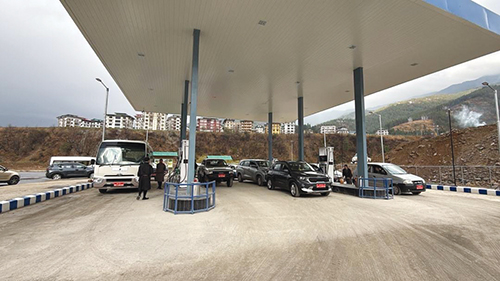
The petrol and diesel prices from 16 July have been kept effectively the same as before.
For example, petrol prices in Thimphu, which were Nu 97.46 per litre earlier, have been kept at Nu 97.46 per litre. This is the same in the case of diesel in Thimphu, where prices are now Nu 98.31 per litre compared to Nu 98.30 before.
There are minor changes of a few chetrums in other places depending on transportation costs.
Earlier, this paper reported that in the last fuel price change on 2 July, the government added a charge of Nu 7.79 per litre to the cost of both petrol and diesel as the Related Adjustment Factor (RAF) to recover the Nu 1.823 billion (bn) spent on earlier fuel price support.
This paper asked the government how the RAF burden has been distributed in the latest price change, but received no answer to its written questions.
The paper had to rely on its sources and found that the RAF burden has been largely shifted to petrol consumers, with an additional Nu 11.81 per litre over and above the normal rate.
For diesel users, the RAF burden is only Nu 2.62 per litre.
To understand this, the invoice or landed price of petrol at the border this time is Nu 71.44 per litre. Then 5 percent excise duty, the import permit fee, depot surcharge, transportation, shrinkage and dealer commission are added, bringing the total price to Nu 81.01 per litre. The government then adds 5 percent GST and the additional RAF of Nu 11.81 per litre, bringing the retail price of petrol to Nu 97.46 per litre.
The RAF burden this time has shifted more towards petrol users because the landing price of petrol is lower at Nu 71.44 per litre compared to Nu 75.56 per litre on 1 July.
On the other hand, the landed price of diesel this time was higher at Nu 82.11 per litre compared to Nu 77.58 per litre on 1 July. This meant the RAF that could be applied was only Nu 2.62 per litre for diesel after all the taxes and charges outlined above.
This may appear unfair to petrol vehicle users as, earlier, when the price support was given, the overwhelming majority of the subsidy went to diesel users.
For example, the peak price of diesel was recorded on 17 April, when it hit Nu 199.66 per litre, necessitating a peak support of Nu 101.35 per litre to maintain the consumer price at Nu 98.31. Around the same time, petrol received a price support of Nu 8.19 per litre to keep its retail price at Nu 102.90 per litre.
This is already leading to questions from petrol vehicle owners who ask why they should bear the cost of the fuel price support that mainly benefited diesel vehicles.
However, it is not so simple because the bulk of diesel is used by the country’s transport sector, such as trucks, and if the government increases diesel prices too much, it can lead to a knock-on effect on the prices of essential goods.
What has not helped is that just when international prices were cooling down due to the ceasefire between Iran and the USA, fighting started again, pushing up fuel prices once more.
Brent crude prices stood at USD 83.11 as of Friday compared to USD 71.52 two weeks ago.
Ironically, India’s crude oil basket price, or the rate at which it buys crude from the international market, has come down from USD 83.22 per barrel in June to USD 74.11 per barrel in July.
However, Bhutan does not get fuel from India at crude oil prices. Instead, Indian Oil Marketing Companies (OMCs) price petrol against the 92 RON Singapore Gasoline benchmark, which represents the price of processed petrol loaded onto ships in Singapore. This is the Asian benchmark for commercial export markets.
The average price under this benchmark was USD 107.78 per barrel in June and is at USD 98.09 in July so far, which explains the price drop. It is on this rate that Indian OMCs add transportation, marketing and other operational margins before selling fuel to Bhutan.
Diesel is priced against the Arab Gulf Gasoil benchmark, which reflects the price of processed diesel loaded onto ships in the Middle East. The average price in June was USD 120.05 per barrel but has increased slightly to USD 121.28 per barrel. Here too, Indian OMCs add their respective margins.
The increase in diesel is only marginal even under the Arab Gulf Gasoil benchmark, but it seems Indian OMCs have passed on a higher increase in cost to Bhutan. This is where greater transparency is needed in terms of a cost breakup which Bhutan asked before, but none is provided.