The Bhutanese Leading the way.
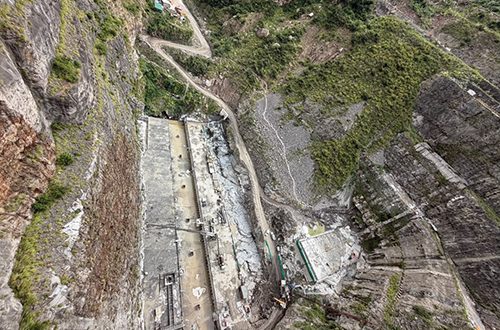
After a delay of around six months, the draft supplementary agreement, along with the finalized construction methodology and schedule for the right bank of the 1200 MW Punatsangchu I project, has finally been shared with the construction company Larsen & Toubro by the overall consultant Water and Power Consultancy Services (WAPCOS) and civil engineering consultant Central Water Commission (CWC).
It will be submitted to the Project’s Technical Coordination Committee comprising experts from both countries for technical review and approval and then to the Project Authority for final approval.
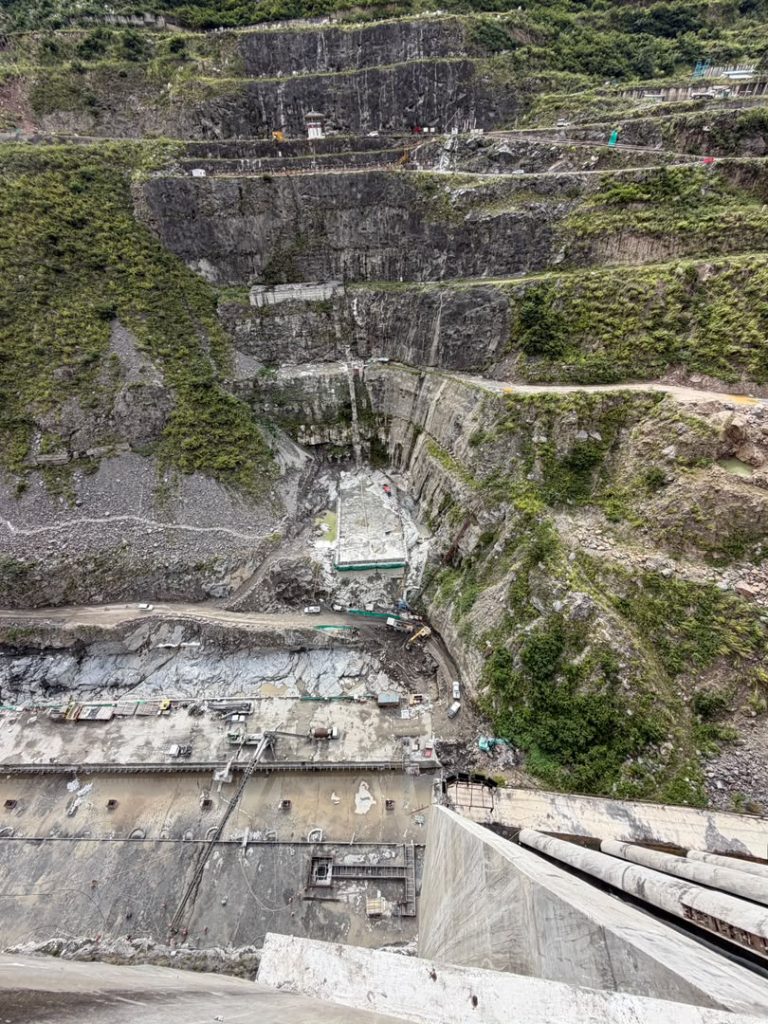
The right bank stabilization measures are expected to start in the first quarter of 2027, after the design is finalized.
The stabilization measures are enormous. Over 5 million cubic meters of overburden will be removed from the right bank slope above the National Highway.
Deep drainage will be constructed to monitor the groundwater levels and seepage. Seepage control measures, including curtain grouting, geomembrane, and compacted backfill, will be implemented.
A total of 366 additional 2-meter-diameter Reinforced Cement Concrete (RCC) large piles are planned under the current stabilization measures. This will take the total RCC to 595, with 229 already executed.
In addition, 815 cable anchors are planned, in addition to 573 already installed. This will mean a total of 1,388 cable anchors.
The current estimated total project cost is about Nu. 170 billion, which is currently under review and subject to change. Of this, the MC-1 Package (Dam) is estimated at Nu. 88 billion.
The project’s current approved cost is Nu 93.75 bn, of which Nu 89 bn has been spent. The cost of the right bank stabilization measures is still being firmed up and will finally depend on the finally approved designs. Bhutan has already agreed to bear 4 billion of the total costs here as Bhutan wanted more overburden removed.
In what will be a first for this size of project in the world, a separate 159 RCC piles are planned in the foundations of Dam blocks 8, 9, 10 and 11, with depths ranging from 16 meters to 32 meters. RCC piles are being placed under these particular blocks due to geological weakness underneath and soft soil, as these blocks fall towards the right bank.
The design and safety analysis have been carried out by the project designer (WAPCOS and CWC) and incorporated into the construction drawings.
In the past, the Bhutanese side had raised apprehensions about putting RCC piles under the dam foundation as it had never been done at this scale before. There are 12 dam blocks that make up the dam, with dam block 1 having two blocks at 1 and 1A and dam block 12 having 12 and 12A.
The ongoing construction work is on raising the heights of dam blocks 3, 4, 5, 6 and 7 so that even if digging is done in the vulnerable right bank area and there is another slide, it does not cover the 3, 4, 5, 6 and 7 blocks.
The spillway, or the place where the water comes out of the same, will be focused on dam blocks 3, 4, 5, 6 and 7, more towards the stronger left bank.
The work on the right bank was supposed to start in April 2026 along with the resumption of the dam construction, but there were delays in approving the final design by CWC and WAPCOS.