The Bhutanese Leading the way.
Scrap export comes to a halt and affects livelihoods of the most vulnerable
More details have emerged on the Nu 10,000 Gunda Tax per truck of scrap demanded by politically connected goons, in addition to the existing Nu 4,000 that is paid to officials in Jaigaon, putting an effective dampener on the scrap and waste recycling business in Bhutan.
Sources in Bhutan and Jaigaon say that the main change is that a new goon close to a relative of a powerful politician from the larger area has come up with the Nu 10,000 fee rate.
This goon has co-opted the local law enforcement and a couple of border guards at the lower level too and has a support staff person in the Indian customs supplying him with information on all trucks entering Jaigaon.
This politically connected goon has used the services of a long-time fixer in Jaigaon, known as a middleman in Jaigaon and familiar to law enforcement and the commission system there, as well as how to extort Bhutanese vehicles coming into Jaigaon.
The modus operandi is that the goon’s support staff source in the customs is suspected to supply the goon with advance information on scrap trucks coming in. The goon and his men do not stop the truck on the main road. They let the truck from Bhutan enter a scrapyard and unload half its goods, and they then suddenly turn up and start filming and saying scrap export is illegal and threaten to call law enforcement and impound the truck and the scrap. They even have a couple of border guards come by to create further pressure.
Three trucks from Bhutan had been caught this way and, from the initial demand of Nu 100,000, they paid Nu 50,000 each.
The settled rate is now Nu 10,000 per truck, shared between the goons and law enforcement. This is above the Nu 4,000 paid earlier to officials taking the total to 14,000.
The scrap movement has largely stopped as, firstly, Indian and Bhutanese truck owners no longer want to carry scrap as it can impact their truck, and Jaigaon and Bhutanese scrap dealers find the new Nu 10,000 Gunda Tax to be too high and unprofitable.
For the scrap and waste recycling businesses in Bhutan, Jaigaon has become a figurative Strait of Hormuz.
Insiders in Jaigaon and Phuentsholing say this level of open extortion would not be possible without the political protection and blessing of the powerful political figure in the area.
What has also not helped matters is that goons who worked for and were loyal to the older political party have now shifted base to the new party, and so this is a combination of old and new goons who are much greedier, impatient, blatant and politically better connected.
Sources in Phuentsholing and Jaigaon said if this powerful new nexus is not dealt with, then it is only a matter of time before they start extorting other Bhutanese vehicles and businesses.
In fact, this trend has already started with the ferrosilicon industries in Pasakha. A source in Jaigaon said that earlier seven to eight trucks of lower-grade ferrosilicon were sold in Jaigaon, with each truck carrying around 30 metric tons. Now the same nexus has started charging Nu 15,000 Gunda Tax for each truck, and the Jaigaon importers deduct that tax from their payment to factories in Pasakha.
However, scrap is not ferrosilicon, and the Nu 10,000 additional Gunda Tax has brought the trade to a halt.
As a result, scrap and recycled waste is being piled up in scrapyards in Phuentsholing, which collect it from various other parts of Bhutan.
With the Gunda Tax coming in, initially a few scrapyard owners in Jaigaon who had already paid an advance to their counterparts in Phuentsholing took the scrap, even paying the Gunda Tax, as they did not want to get their money stuck. However, now things are not moving.
The impact can already be seen all the way here in Thimphu.
A member of the Bhutan Waste Management and Recycling Association (BWMRA), General Secretary Leki Dawa, said while licensed waste recyclers may number around 250 to 300 in the country, when the informal and unlicensed are added, the numbers could be double.
He said there may be around 800 to 900 people involved in this business at various levels in 20 Dzongkhags. He said the most vulnerable are the waste collectors, who are generally very poor, and in a city like Thimphu, they are up around 2 to 3 am collecting PET bottles and cans left overnight or by youngsters partying. These waste collectors, who range from the old and abandoned to the young and are invisible to most eyes, sell these to scrapyards to eke out a living.
Before the Gunda Tax, these people could earn Nu 25 per kg of PET bottles and Nu 70 to 80 per kg of cans, but now the rate is Nu 20 to 18 per kg for PET bottles and Nu 30 to 35 per kg of cans.
The BWMRA is waiting for the Jaigaon scrap dealers to write to them, and they then plan to approach the government and Foreign Ministry to take up the matter with their Indian counterparts.
Both scrap dealers and waste management companies in Bhutan and India say the only way out is to formalize the scrap trade between the two countries.
The Bhutanese put up the question to the Ministry of Industry, Commerce and Employment on the Gunda Tax and the need for formalization.
The Ministry said that since August 2021, the export of scrap materials from Bhutan to India was restricted due to India’s import policy on scrap materials. The Ministry said it had raised the issue with the Government of India (GoI) through diplomatic channels, including during the Bhutan-India Commerce Secretary Level Meeting (CSLM) held in Thimphu in September 2024.
During the CSLM, the GoI conveyed that they were positively considering the notification of the Jaigaon Land Customs Station for the import of unshredded metallic waste and scrap from Bhutan.
In addition to Jaigaon Land Customs Station being notified, it was also informed that there were certain formalities that the scrap exporters would need to complete, such as applying for a Preshipment Certificate (PSIC) from the authorised Preshipment Inspection Agencies (PSIA) for the export of certain types of scrap from Bhutan to India. The challenge then was that there were no such PSIA agencies within the Jaigaon area. This information was also shared with the scrap dealers.
The Ministry said it continues to follow up regularly on the issue through the Ministry of Foreign Affairs and External Trade, as well as through other relevant forums.
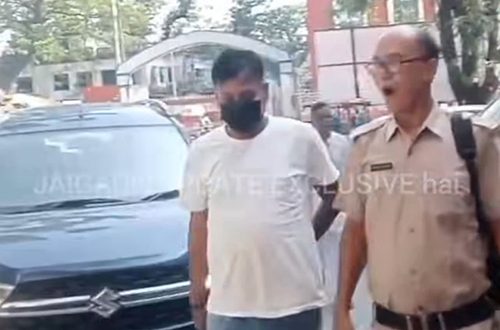
Update: The above article was published on Saturday morning. By Saturday evening the Jaigaon Police arrested five key people running the Gunda Tax reported by The Bhutanese.
The arrested people are the Bharatiya Janata Mazdoor Sangh (BJMS) leader Safikul Alam, Bal Bahadhur Tamang (Polay), Jalaluddin (Jarnal), Mahabool Alam and Ansarool Sheikh (Gelgulu). The arrested were being presented to the Alipurduar court.