The Bhutanese Leading the way.
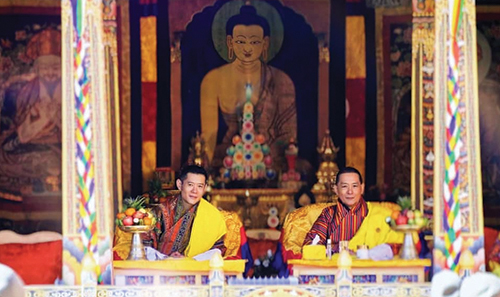
By Brian. C Shaw
Perceptions matter. Decades ago, on an overnight train from Bangkok to the Lao border, I fell to sharing beers with a Thai army officer. After discussions, he wisely observed: “Without our King, there would be no Thailand”.
And without “our” King there would be no Bhutan. Thailand and Bhutan, so different in size and in other ways, share a similar Buddhist world-view. Without a King in Bhutan, there would be no unity, there would likely be confusion and jealousy, and many people would probably conspire to pull others down.
And yet, in Bhutan there is the courteous and heartfelt custom of referring to “our” King. It was usual for government workers to informally – but without disrespect – refer to HM the Fourth King as “Boss” during his tenure to 2006. The present solemn ceremonies in Bangkok of respect for late Thai Queen Sirikit are shared by the personal presence of Bhutan’s King and Queen, further enhancing understandings between these countries.
His Majesty the Fourth King has spent most of his working years in preparing and consolidating institutions that would give substance to his father’s vision of a modern and developed people. There were many obstacles, not least of which was the limited available resources. Neighbouring China was still clarifying its developmental and political goals, suggesting reservations in policy, while neighbouring India became willing to support Bhutan’s development plans significantly. The “southern problem” from 1990 onwards also distracted development for several years.
Former Chief Justice Sonam Tobgye has recently given an extended summary (covering 12 full pages of a fraternal weekly newspaper) of important achievements during the Fourth King’s reign: no need to repeat these. But I wish to briefly dwell on a few events worth reflection.
First: I saw with my own eyes the tears in ministers’ eyes, at the National Assembly building, when the King announced the beginning of his political reforms. Tears are of course from emotion: they are not a basis for policy.
Second, when HM announced to a later Assembly the drafting of a Constitution with a party-political basis, there was widespread and well-reported absence of enthusiasm. In response to a view that people should be thrown into the pool in order to learn to swim, some muttered that they preferred to walk at their own pace, and besides they already had the King.
Third, HM recognised the timeliness of further enhancing Bhutan’s state sovereignty, by urging settlement of Bhutan’s external borders with India in time for enactment of a Constitution. Many pending border strip-maps were subsequently exchanged between India and Bhutan, but the east and west trijunction alignments await prior Sino-Indian agreement. So, national sovereignty remains elusive and incomplete until Bhutan’s external frontiers are agreed.
Fourth, addressing the outgoing cabinet in 2006 as retiring monarch, the Fourth King spoke strongly of establishing long-term trust funds, to underpin the prosperity of the Bhutanese people against possible temporal excess expenditures by politicians. At this meeting, on taking leave, the then Chief Justice felicitously observed that His Majesty during his term had helped “create a people” by “giving them the identity that they were so proud of”. The populace (he said) “had been poor and down-trodden in the past but now looked into the future with confidence and pride”. That sharp truth remains, although weakened by subsequent migration of the young to employment in the Middle East and Australia.
Human life being unpredictable, we must work with what we have, trying to foresee the outlines of the future to enhance our chances for survival. Development and modernization decisions must take adequate account of geology, geography, and global warming.
“Democracy with Bhutan characteristics”, a work-in-progress, is a subject to be wrangled elsewhere. Yet it has relevance here. In March 2008, the Bhutanese citizen’s right to rule themselves, passed in trust a century earlier to the First King by signet-seal and thumb-print from the public, was returned to the often bemused public. The years since have witnessed a growth in misuse of public persons’ brief authority, and also imprudent use of public treasure that had been so carefully gathered together. The struggle against corruption at all levels is a reminder that Bhutan’s economic and political achievements are the result of constant attention to detail, as well as constant reassessments of the public interest and the society’s ability to sustain in times of stress.
After voluntary abdication, the moral authority of the Fourth King remains high. He remains alert, mostly in the background, informally yet astutely observing the scene with raven eyes. Surprised citizens may often chance upon him in real life in mufti, disguised as an energetic eco-cyclist. He still energises all who meet him, and has encouraged many to adhere to and advance his vision.
“Live long and prosper”: continue to give reflective guidance from hard-wrought experience. This is the sincere and heart-felt wish of the people for His Majesty Jigme Singye Wangchuck, the Fourth King of Bhutan, father and grandfather, on the occasion of his 70th Birthday.
This nearly-90-years-old observer takes off his many hats – with deepest respect – to HMs the Fourth King, the Fifth King, and the Sixth King-in-waiting. Let’s share another glass with the Thai army officer, for a collective toast – “To our Kings!”.
Tashi Delek to all.
The writer also known as the ‘Hong Kong Chimi’ has published multiple research papers on Bhutan in International Journals and is a recipient of the National Order of Merit Gold for his services to Bhutan.