The Bhutanese Leading the way.
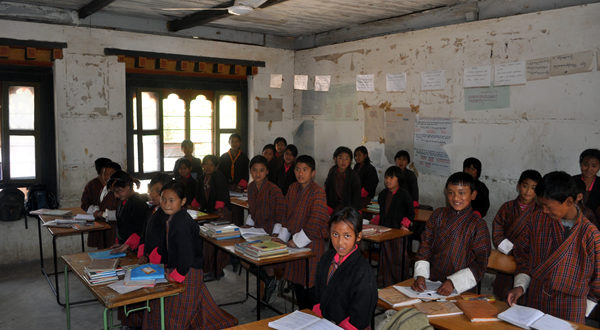
The Education Minister, Yeezang De Thapa, elaborated on the alignment of Bhutan’s education system with the Cambridge Curriculum, and highlighted its significance.
During the 10th Sitting of the Fourth Parliament’s Fourth Session, Lyonpo Yeezang De Thapa reminded the Royal Education Kasho from His Majesty The King that the Ministry of Education shall be committed to elevating the quality of Bhutanese education to global standards.
“The Education Ministry itself is also committed to providing 21st Century education to students, making them locally rooted and globally competent,” Lyonpo said.
Lyonpo added that the ministry aims to deliver a quality education that is comprehensive and grounded in values.
She further highlighted that of the 193 countries registered with the United Nations, more than 163 follow the Cambridge curriculum, with over 10,000 schools implementing it globally.
Lyonpo Yeezang De Thapa said, “Everyone questions the quality of education. Our ministry has the BCSE examination system, but during our time, if any foreign parties asked about the quality of our education, we did not have an accurate answer.” She further said, “But now our education system is aligned with international standards, and we can confidently say that it is aligned with the Cambridge Curriculum.”
Lyonpo noted that it has been 60 years since the implementation of the education system in Bhutan, and only now has the system been brought up to an international standard. “For the ministry, bringing the Cambridge Curriculum is a historic milestone in the history of education,” the Education Minister said.
While discussing the progress and process of implementing the Cambridge Curriculum, Lyonpo said that when the ministry first received the proposal, they learned that it usually takes more than two years for a country to complete the alignment.
“The Cambridge team said that they would need two and a half years; however, the ministry told them that we did not have enough time and that it should be done within a year,” Lyonpo said. She added, “Recognizing our commitment and seriousness, the alignment of the curriculum was achieved in just eight months.”
Lyonpo also emphasized that there should be no doubts about the quality of the alignment, noting that although it was completed in just eight months, it strictly adheres to the curriculum’s standards as verified by the Cambridge team.
Most importantly, Lyonpo mentioned that more than 400 teachers have been tasked with developing textbooks. “The new textbooks aligned with the Cambridge Curriculum, covering classes PP to 12, include about 103 different textbooks,” Lyonpo said.
This is the first time such an initiative has been undertaken by the ministry and the teachers; however, the Education Minister noted that the ministry is seeking guidance from the Cambridge team throughout the process.
The ministry further noted that they have only three months to develop the new textbooks aligned with the Cambridge Curriculum, as the curriculum is set to be implemented from the 2026 academic year.
Lyonpo said, “The curriculum developers, along with the teachers, are working on it by contextualizing it to Bhutan, and the Dzongkha subject is aligned with Cambridge literature.”
According to the Minister, the curriculum developers and teachers are also working during weekends. “Since the Cambridge team usually does not respond over the weekends, the teachers have mentioned the given limited timeframe. Thus, the Cambridge team has been assisting even on weekends by responding to emails,” Lyonpo said.
For the past 60 years, Bhutan’s education system has largely focused on memorization and local standards, limiting students’ critical thinking and global competitiveness. As reported in our previous article, the MoESD is now aligning the system with Cambridge International standards.
The reforms include a curriculum emphasizing critical thinking and problem-solving, an internationally benchmarked assessment and grading system, extensive teacher training, and efforts to achieve international accreditation.
These changes aim to prepare students for global challenges, enhance employability, and open opportunities for higher education both at home and abroad.
Expansion of Alternative Pathways for Students
Lyonpo Yeezang De Thapa also spoke about TVET education, citing observation of students who had failed four to five times in a single grade or multiple times across grades.
Lyonpo encouraged these students to consider the TVET path, adding that the MoESD would provide guidance. Highlighting the importance of skills, Lyonpo shared that a recent job vacancy received 5,103 applicants, but only about 300 were selected. “This is because the applicants had the degree and required certificates but not the skills,” Lyonpo said, explaining why the ministry is promoting TVET education.
In addition, MoESD has collaborated with Singapore institutions to introduce the Multi-Pathway Education Module at Gedu College of Business Studies, a three-year diploma program set to begin in August 2026.
The diplomas offered will include Agriculture Entrepreneurship, Healthcare Services and Hospital Operations Management, and Aviation and Airport Operations Management.
Similarly, TVET education will soon be made available for students interested in completing eighth grade, providing alternative pathways to skill development and employment.