The Bhutanese Leading the way.
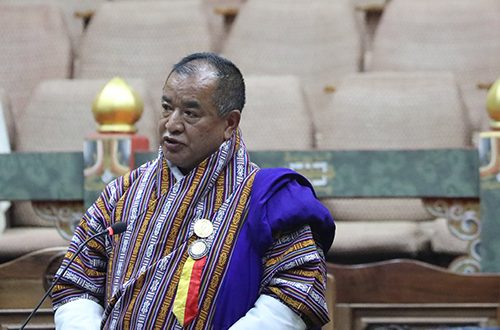
Thrimshing-Kangpar MP Damche Tenzin pointed out that under Pledge No. 4 of the People’s Democratic Party (PDP) manifesto, the government committed to ensuring that every Gewog Health Center is staffed with one doctor and adequate health personnel, including at least one female health worker.
The MP said that more than two and a half years after the government assumed office, many parts of the country continue to face shortages of HAs and female health workers.
Drawing attention to the situation in his constituency, the MP said that the Thungkhar, Phegpari and Passaphu sub-posts currently have only one male HA each serving around 1,460 residents, including students residing on school campuses.
He said that whenever the HA is away from the sub-post, residents are often forced to travel long distances.
“Similarly, there appears to be inadequate deployment of HAs-particularly female HAs-across the country to meet essential healthcare needs and provide basic health services,” the MP stated.
In its response, the Ministry of Health (MoH) said while the approved staffing requirement for 298 healthcare centers stands at 637 HAs, the current workforce consists of only 558 HAs, including those on Extraordinary Leave and Long-Term Training. This leaves a shortage of 79 positions nationwide.
The MoH said, “The shortfall has resulted in challenges in maintaining full staffing coverage across all sub-posts and outreach facilities, particularly in remote and hard-to-reach areas where access to healthcare is already constrained by geographic and logistical barriers.”
According to the ministry, available personnel are deployed based on factors such as patient load, accessibility and population vulnerability.
The MoH added that female health workers are prioritized for areas with higher maternal and child health service needs whenever possible.
To address the shortage, the ministry has increased the annual intake of HA students at the Khesar Gyalpo University of Medical Sciences of Bhutan from 25 to 40. According to the Ministry, this is expected to gradually strengthen the health workforce in the coming years while efforts continue to improve deployment and retention of existing staff.
The ministry also highlighted the introduction of Mobile Medical Units (MMUs) to improve access to healthcare services in underserved communities.
According to the ministry, 29 MMUs have been secured with support from the Asian Development Bank’s Japan Fund for Poverty Reduction, with the first 10 units already deployed and operational in several dzongkhags.
The MoH said the units will provide essential services, including outpatient care, maternal and child health services, reproductive health services, non-communicable disease screening and health promotion activities in remote areas.
However, the ministry acknowledged that staffing all units with the required healthcare professionals remains a challenge due to the existing workforce shortage.
A proposal for additional human resources has been submitted to the Royal Civil Service Commission, while budget provisions have also been proposed to support the operation and maintenance of the mobile units.
The ministry stated that it remains committed to improving equitable access to healthcare services across the country and strengthening the health workforce to meet growing healthcare demands.