The Bhutanese Leading the way.
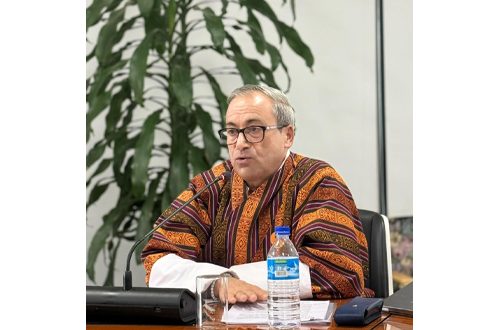
Concerns over the safety and welfare of Bhutanese living and working in the Gulf region were raised both in the National Assembly and during the 28th Meet-the-Press session on 5th June 2026, as the government detailed measures being taken to monitor the situation and prepare for any potential deterioration in the ongoing Middle East conflict.
In the National Assembly, Member of Parliament (MP) of Bji-Katsho-Uesu constituency, Lhendup Wangdi, questioned the Foreign Minister on the impact of the escalating conflict in the Middle East, which began on 28th February 2026 and has affected regional security, air travel, employment and civilian movement across several Gulf countries.
The Foreign Minister, Lyonpo D.N Dhungyel informed the House that as of 4th May 2026, there are 7,786 Bhutanese nationals residing in Gulf Cooperation Council (GCC) countries, accounting for around 11 percent of the 71,327 Bhutanese living abroad across about 140 countries.

Of the total, 5,493 Bhutanese are in Kuwait, 1,168 in Qatar, 974 in the United Arab Emirates, 133 in Bahrain and 18 in Oman.
The same issue was also raised during the government’s Meet-the-Press session, where questions focused on the latest situation facing Bhutanese citizens in the region and the government’s preparedness to provide assistance if required.
Lyonpo said that the Royal Bhutanese Embassy (RBE) in Kuwait has been maintaining close contact with Bhutanese communities through local coordinators, social media platforms, and direct communication channels while providing regular updates to the ministry.
He said that the RBE, Kuwait has also been monitoring travel, safety and employment conditions, issuing travel advisories and updated flight information, and coordinating with employers, employment agents and local authorities to assist affected Bhutanese nationals.
Foreign Minister said the embassy has helped Bhutanese workers facing employment disputes, unpaid salaries, visa-related issues and difficulties arising from the conflict.
Assistance has also been provided for transit arrangements and emergency travel situations.
Responding to concerns raised by MPs on whether Bhutanese workers wishing to return home could face challenges due to visa or documentation issues, the minister said the embassy would directly intervene in such cases and had already been assisting workers encountering such difficulties.
He added that Bhutanese nationals who have not yet registered with the RBE, Kuwait are encouraged to do so, as registration enables authorities to provide timely assistance and support during emergencies.
Lyonpo said that since the onset of the conflict, 180 Bhutanese overseas workers have returned permanently to Bhutan. In addition, 128 workers are currently in Bhutan on vacation, while 123 have already returned to their countries of employment after their leave.
Questions were also raised by MPs regarding employment opportunities for returning workers, and whether the government would be able to support a larger number of returnees if the security situation worsens.
Sergithang-Tsirangtoed MP Lhakpa Tshering Tamang questioned whether the government would be prepared to provide employment opportunities, entrepreneurship support and access to financing if thousands of Bhutanese workers were forced or are willing to return from the region.
In response, the Foreign Minister said the government has a responsibility to support returning Bhutanese regardless of the numbers involved.
“If there are situations of many Bhutanese coming back, it is our responsibility to provide them jobs, whether they are in the hundreds or thousands,” Lyonpo said.
The Minister of Industry, Commerce and Employment, Lyonpo Namgyal Dorji, informed Parliament that the government has already established a National Reintegration Program to support Bhutanese returning from overseas employment.
According to the Minister, 716 Bhutanese have registered under the program. Of these, 601 are currently in Bhutan, 323 have been referred to jobs and 59 have already joined employment opportunities.
The program also supports entrepreneurship and investment initiatives for returnees.
Lyonpo said that of the 180 Bhutanese who have returned permanently from the Gulf region since the conflict began, 90 have either secured employment or joined skilling and entrepreneurship programs.
These include permanent jobs, internships, skills training programs, entrepreneurship boot camps and business development initiatives, etc.
Addressing concerns about Bhutanese seeking employment abroad despite the conflict, he said that the government has not imposed restrictions on overseas employment, but has instead strengthened policies aimed at ensuring safer migration pathways and stronger reintegration measures for workers who choose to return.
The Foreign Minister also outlined the government’s contingency plans should the security situation in the Middle East deteriorate further.
A six-agency coordination mechanism comprising the Ministry of Foreign Affairs and External Trade, Ministry of Industry, Commerce and Employment, Ministry of Home Affairs, Ministry of Infrastructure and Transport, Ministry of Finance and the RBE in Kuwait has been established to coordinate emergency responses and repatriation efforts.
The government said the contingency framework includes monitoring developments, maintaining communication with Bhutanese nationals, arranging emergency travel documentation, assessing evacuation options and preparing financial and logistical arrangements for repatriation.
The RBE, Kuwait has been designated as the regional operational hub for any evacuation efforts, with options ranging from commercial and chartered flights to land transfers through alternative airports depending on the prevailing security situation.
The government said it continues to closely monitor developments in the region and stands ready to activate contingency measures to ensure the safety and welfare of Bhutanese citizens if circumstances require.