The Bhutanese Leading the way.
… Exploring Nature-based and wildlife tourism in Jomolhari
By Yangchen C Rinzin
I packed my bag for our field mission to Jomolhari with a clear purpose. It was to meet people, talk about our project, install camera traps for snow leopards, and understand the realities of human–wildlife conflict in these landscapes.
The plan was straightforward for me as a Communications Officer. The assignment was familiar, which was to observe, document, and gather communications material. It was meant to be just another official trip, and I packed for it that way.
On May 24, our team of eleven set out from Shana, Paro, toward Jhomolhari in Soe Gewog. Like most work trips, it promised a shift in geography, not necessarily in perspective.
But the landscape refused to adapt to that expectation. The trek, stepping across uneven stones, leaping over streams, and ascending into Jigme Dorji National Park (JDNP), demanded full presence. Every step required care and intention. There was no room for abstraction.
The terrain insisted that I be present physically and mentally. There was fatigue, of course, the kind that settles deep into the legs and chest. Yet, when we reached our first halt at Thangthakha camp, perched at 3,594 meters, I noticed the absence of urgency. Nothing felt hurried.
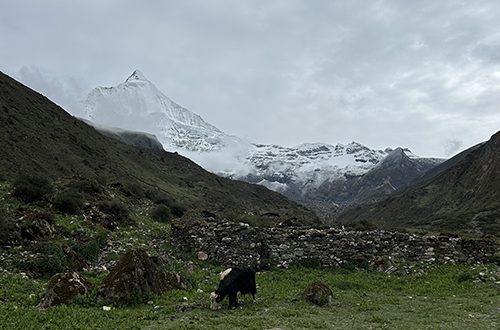
The second day’s hike to Jangothang, our true destination, marked a shift. Even before we began, Mount Jomolhari revealed a glimpse of its snow-covered peak, building anticipation. As I moved along the trails through dense forests, alpine meadows, across rivers and bridges within JDNP, and listened to our local guide, Pema Lhamo, speak about Jomolhari, a thought stayed with me- perhaps we are not seeing Jomolhari for what it truly is.
Jomolhari is often known through its festivals, treks, and striking landscapes that have drawn visitors for years. As herders passed us in the glacial valleys, it struck me how narrowly we frame this place, mostly through culture and scenery.
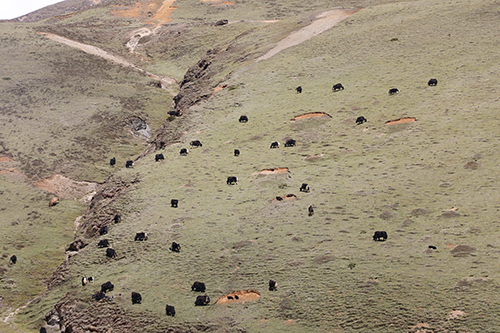
Then my colleagues began pointing out different types of birds, flowers, trees, and yaks grazing quietly along the source of Pachhu. The details I had overlooked before. The sight of a Himalayan marmot and red fox, my first, became a turning point. It made me realise how little attention we give to the wild side of Jomolhari.
Jhomolhari as nature-based and wildlife tourism from what I saw
Jomolhari can be more than just a trekking destination or one beyond culture and ecotourism. This realisation came not only from my six-day stay, but also from a quiet conversation over a cup of suja in a modest home.
Perhaps it can evolve into a model for nature- and wildlife-based tourism, something WWF-Bhutan and the government are already exploring. The foundations are certainly there. As part of JDNP, Jomolhari stands, as one local paper aptly described, as a “living conservation jewel where nature, wildlife, and human culture coexist in rare harmony.”
Jomolhari is a stronghold for snow leopards, along with species like blue sheep, Himalayan marmots, Pallas’s cat, and highland birds such as the Himalayan monal and Himalayan griffon vulture. That is undeniably true. Yet, despite this richness, wildlife remains largely overlooked in the way tourism here is understood and experienced. While most visitors and even locals have rarely seen these animals, their presence is felt through lost livestock. This is where, to me, even though not in sight, they experience the place in understanding.
WWF-Bhutan’s prospectus, “Investing in Bhutan’s Flagship Nature-Based and Wildlife Tourism”, thoughtfully explores models such as guided wildlife tracking, homestays, interpretation of camera trap data, and community-led narratives. The more I spoke with communities and rangers in Soe Gewog, the clearer it became that these ideas already exist in practice, but remained untapped in Jomolhari.
From children to adults to elders alike, local communities hold deep knowledge of wildlife movements, weather patterns, and pasture dynamics. A thought occurred, what if these communities were not just participants in tourism, but were leaders? Community-led approach activities such as training local herders as wildlife guides and wildlife trackers, and creating snow leopard tracking routes along existing trails, could enrich the visitor experience. This would also place local knowledge at the heart of conservation and tourism, benefiting both people and nature.
Even camera traps, which I saw were installed to study snow leopard ecology during our visit, could become powerful means to connect visitors and species. The images combined with local herders’ knowledge can strongly contribute to non-intrusive wildlife interpretation. This would allow visitors to see wildlife, especially snow leopards, through camera traps without disturbing habitats. To ensure local ownership of such tourism benefits and conservation outcomes, Jomolhari can be anchored as a snow leopard stewardship programme.
What stayed with me is how such an arrangement can help locals generate revenue through these activities and help back conservation efforts. This would also reduce their dependency on yaks alone. If approached carefully, wildlife tourism could simply help sustain both communities and biodiversity.
Complementing current human-wildlife coexistence
As much as I found myself absorbed in the beauty of the mountains, the reality felt heavier the more I began to speak with the locals and the forest officials. Beneath the stillness of Jomolhari, communities continue to live with the constant challenge of human–wildlife conflict despite several ongoing interventions.
As Aum Chimi Dema, a herder, explained to me, snow leopards often target young calves, and such losses have become a recurring part of their lives. Yet, what stood out was not frustration, but a quiet sense of acceptance.
“We are living with it. We cannot harm the snow leopard. At least when a snow leopard kills, it leaves half of the carcass. We are able to sell the remaining meat and earn something. But it is different with other wild animals—they take away everything.”
There was a certain practicality in her words, but also resilience.
Efforts by agencies, including WWF-Bhutan, have introduced measures such as corral fencing, portable solar fencing, and permanent chain-link enclosures. From what I gathered, these interventions have made a difference, helping communities reduce livestock losses and better manage risks.
At the same time, what fascinated me was how people identify the presence of a species they rarely see. As Tshering Dorji, a highlander, shared, “We know the snow leopard exists because it leaves half of the carcass after killing a yak and sometimes returns to feed on the remaining carcass. That is usually how we know it was there. We also believe the snow leopard is important—it helps control blue sheep that damage our vegetation. We never burn waste, because we believe it angers the local deity and brings the snow leopard closer to disturb our livestock.”
These beliefs, layered with lived experience, reveal a relationship that goes far beyond conflict. There is loss, yes but there is also tolerance, understanding, and even a form of coexistence shaped by culture and spirituality.
Over time, communities here have adapted to depredation. But this adaptation does not mean that they should simply endure it. Instead, it made me think, what if this coexistence could become a foundation for something more?
This is where the idea of wildlife tourism began to make sense to me, not as an external concept, but as a natural extension of what already exists. The question, then, is not just how to reduce conflict, but how to ensure that highlanders’ livelihoods are strengthened without disrupting their way of life.
Wildlife tourism, if carefully developed, offers that possibility. It allows communities to see value in conservation, not only in protecting biodiversity, but in creating new sources of income through guiding, homestays, and sharing their knowledge of the land.
Coexistence here is not theoretical. It is lived in. By the time I left, this idea no longer felt abstract. It felt necessary.
Yangchen C Rinzin is a Communications officer with WWF-Bhutan. She can be contacted at yrinzin4@gmail.com