The Bhutanese Leading the way.
The Ministry of Finance (MoF) clarified that while the Property Tax Act of Bhutan 2022 allows property tax payments to be made in instalments, such arrangements are intended as a discretionary relief measure for taxpayers facing genuine financial hardship rather than a standard mode of payment.
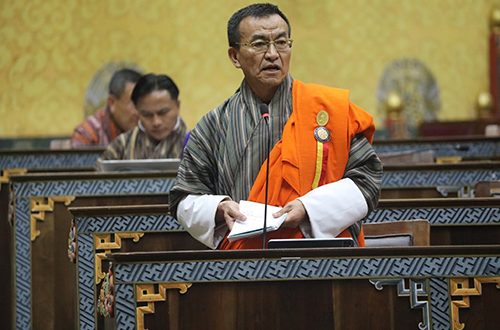
The clarification came in response to a question raised by South Thimphu Member of Parliament (MP) Tshewang Rinzin during the Question Hour of the National Assembly (NA), who called for greater flexibility in property tax payments. The MP stated that many citizens continue to face difficulties paying property taxes within prescribed deadlines despite deferments, and suggested allowing taxpayers to pay at any time during the year, provided the full amount is settled within the same fiscal year.
In response, the MoF stated that the Section 29 of the Property Tax Act empowers it to permit payment of property tax by way of instalments, with or without interest, thereby providing flexibility in the mode of payment within the statutory framework. However, the MoF emphasized that this provision must be read together with Section 28 of the Act, which stipulates that property taxes are due and payable by 31st December each year.
According to the ministry, while the Act provides flexibility regarding the manner of payment, it also envisages a clear annual assessment and payment cycle.
The MoF said the annual payment requirement is supported by important administrative and technical considerations. Property taxes are assessed on an annual basis and are linked to valuation parameters that require certainty and finality within a defined period. Building tax, for example, is based on annual rental value, while assessments for cultivated land are undertaken periodically.
Allowing unrestricted payments throughout the year, the ministry noted, would complicate the assessment process, delay reconciliation and revenue accounting, and increase administrative costs associated with tracking partial payments, follow-up, enforcement, and annual closure of accounts.
It further stated that such an approach would entail opportunity costs, as administrative resources devoted to managing continuous instalment arrangements would necessarily reduce the capacity available for other functions, including taxpayer services, compliance monitoring, valuation updates, and further improvements to the property tax system.
However, the MoF acknowledged that limited flexibility may be necessary in genuine cases of financial difficulty.
It explained that while a formal instalment framework is not explicitly prescribed for all taxpayers, the existing legal framework already provides sufficient flexibility for instalment arrangements where circumstances warrant such relief. In particular, Section 51 of the Rules provides that, prior to initiating recovery measures under Section 32 of the Act, the Department may recover outstanding tax and penalty dues by entering into an instalment agreement with the taxpayer in accordance with Section 29 of the Act.
Accordingly, the MoF said such flexibility is intended to operate as a discretionary relief mechanism rather than a routine mode of payment, and its application is subject to defined conditions and administrative judgment.
The ministry clarified that instalment facilities are not automatic or available as a matter of right. Taxpayers seeking such relief must submit a formal application, and the Department may approve instalment arrangements on a case-by-case basis depending on individual circumstances and demonstration of genuine financial hardship.
The ministry stated that discretion is intended to ensure that instalment relief is granted only where justified, rather than being applied as a default payment mechanism.
Addressing concerns regarding taxpayers in Thimphu, the MoF noted that the property tax system is value-based. Higher tax contributions from Thimphu largely reflect higher property values and the concentration of buildings and properties that generate rental and commercial income.
The MoF said higher collections do not necessarily indicate a disproportionate burden but are consistent with the underlying principles of equity and ability to pay embedded in the value-based taxation framework.
The ministry also stated that compliance challenges are not necessarily attributable to taxpayers’ inability to pay.
While the compliance rate was relatively low as of March 2024, it improved to 85 percent by the end of June 2024 and further increased to 98 percent by the end of December 2024. According to the MoF, this demonstrates that compliance improved significantly over time as taxpayers became more familiar with the new system and fulfilled their obligations.
Similarly, the ministry said the decline in property tax collections between FY 2023–24 and FY 2024–25 cannot be attributed solely to non-compliance.
A contributing factor was the increase in concession claims arising from greater awareness and improved reporting of cultivated land, as well as policy measures such as the 90 percent concession granted in 2025 for urban areas where development is not permitted. These measures reduced the effective tax base and consequently affected revenue collections.
Based on administrative observations, the MoF said delayed payment is frequently attributable to procedural and awareness-related factors rather than an inability or unwillingness to pay.
These include cases where taxpayers generated payment advice numbers but assumed payment had already been completed, cases involving omission of certain plots by owners of multiple properties, and cases of jointly owned properties where there was a misunderstanding regarding individual liabilities.
The MoF further highlighted that beyond statutory instalment arrangements, the existing system already permits taxpayers to make payments on a plot-wise basis. This, it said, provides an additional layer of operational flexibility by allowing liabilities to be settled progressively across properties within the annual tax cycle.
The ministry stated that in effect, this functions as a structured form of phased payment, even though it does not constitute a formal instalment arrangement under the Act.
The MoF concluded that while it recognizes the intent behind providing greater flexibility to taxpayers, the existing framework seeks to strike an appropriate balance between taxpayer convenience, administrative efficiency, certainty in assessment, and prudent revenue management.