The Bhutanese Leading the way.
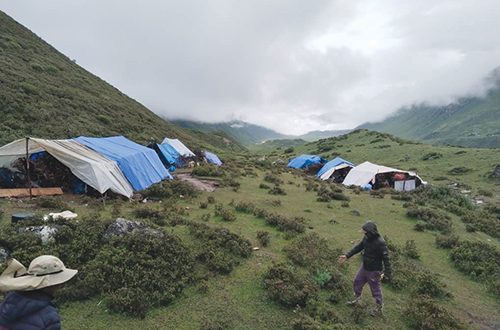
With a looming Glacial Lake Outburst Flood (GLOF) risks that haunts the people living in Thangza and Toenchey villages in Lunana, the need for the planned village relocation is extremely urgent to avert a catastrophic disaster.
In the event of the outburst of Thorthomi Lake, people living in Thangza and Toenchey villages below have only around 16 minutes of lead time to react, making it an urgent priority to relocate these villages with urgency.
While the government recognizes this major threat as an urgent priority, there lies a huge funding gap for the relocation as it requires a more extensive financing package for building resilient infrastructure in the new relocation site.
Therefore, in order to progress, the Department of Environment and Climate Change (DECC) under the Ministry of Energy and Natural Resources (MoENR) is currently taking the initiative in securing funds for the implementation of the relocation of Thangza and Toenchey villages.
The DECC submitted a proposal of securing USD 7.9 million to the Fund for Responding to Loss and Damage (FRLD), an entity under the United Nations Framework Convention on Climate Change (UNFCCC) which finances initiatives to help vulnerable communities to recover from climate-induced losses and damages.
With a lead time of barely 20 minutes, a spokesperson from DECC said that the only viable option for these villages is relocation to avoid a catastrophic disaster that may lead to loss of life and livelihoods.
He said, “The primary risk to this timeline is the availability of funding. Without secured financing, a safe and dignified relocation cannot proceed.
He added that the matter is not simply moving of households. Rather, it requires a “comprehensive package of climate-resilient housing, clean water and sanitation systems, schools, health facilities, and community infrastructure built to withstand the harsh high-altitude conditions of the new settlement site.”
For now, the department has just applied for the Loss and Damage funding. There is no commitment as of yet.
Given that the funding request is approved, he said that the relocation of the Lunana communities of Thangza and Toenchey is expected to begin as early as 2027, with resettlement targeted for completion by 2029.
The new relocation site has been identified and demarcated by the Gasa Dzongkhag Adminstration, recommended by the National Centre for Hydrology and Meteorology (NCHM) after conducting detailed assessments of Thorthomi and Rapstreng Lakes.
The new location is situated at 300 metres higher elevation, outside of the GLOF floodpath and has been identified as a safe site. It is positioned on a much higher ground within the same landscape which is specifically chosen to be outside of the potential flood inundation path.
In addition, the Gasa Dzongkhag and Lunana Gewog administrations have already plot demarcation, secured land registration approvals for households and even identified domestic water sources at the new sites.
The spokesperson said that even the community members have expressed their readiness to relocate, committing their own labour in doing so. The major challenge remaining is to secure international funding to cover the cost of materials and the infrastructure.
The spokesperson said, “Should the FRLD application be successful, a robust, multi-layered oversight framework will be in place to ensure that the funding reaches the communities.”
A dedicated Project Management Unit (PMU) will be set within DECC for the operation of day-to-day coordination, tracking progress and ensuring accountability across all implementing agencies.
Additionally, a Project Steering Committee will be established for strategic oversight, co-chaired by MoENR and UNDP, with membership drawn from the Ministry of Finance, the Department of Local Governance and Disaster Management, and local government representatives.
“The committee will review and approve annual workplans and budgets, monitor progress against targets, and direct corrective action wherever implementation falls short,” the spokesperson said.
“If the project is approved, Bhutan will have a comprehensive, transparent, and independently verified funding management system in place, one that is designed specifically to ensure that these critical resources flow efficiently and accountably to climate-affected communities who need them most,” the spokesperson added.
In an earlier report in January 2025 this paper had pointed out that due to lack of support and resources residents of Thangza and Toenchoe Chiwogs in Lunana, Gasa, faced freezing temperatures and inadequate shelter in plastic tents as they struggled to rebuild their lives after relocating in June 2024 to escape the looming threat of a GLOF.
The relocation, aimed at protecting them from the dangers posed by the Thorthormi and Raphstreng lakes, has been marred by inadequate resources, poor infrastructure, and lack of government support.
The relocation sites, Damthangkha, Bayza-Gangjuk, and Dungbiteng were identified as safer alternatives, with lands measured and demarcated but there are no facilities there and although the gewog budget provided water supply, other essential services, such as electricity, proper toilets, roads, and communication networks, are missing.
Building permanent homes was proving to be a monumental challenge as constructing a single house will take 9 to 10 years because they need to bring materials like wood from places that are a two-to-three-day journey away. Without roads, they rely on people to carry these loads on their backs, which is costly and time-consuming.