The Bhutanese Leading the way.
The Minister for Infrastructure and Transport Chandra Bahadur Gurung gave a comprehensive analysis of road closures in Bhutan and what is being done about it.
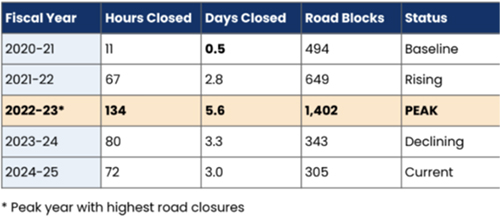
Five-year road closure duration analysis
Comprehensive analysis of road closure data across five fiscal years reveals a deeply concerning trajectory of increasing closure durations. This escalation is particularly pronounced during the monsoon season, when heavy rainfall consistently triggers landslides, flash floods, and debris flows that obstruct critical highway corridors throughout the country.
The data presents a definitive pattern of infrastructure deterioration. In FY 2020-21, roads remained closed for an average of 0.5 days per incident, establishing the baseline condition. By FY 2022-23, this duration had escalated to 5.6 days, representing a 12-fold increase from baseline. Although the average closure duration has moderated to 3.0 days in FY 2024-25, this figure continues to represent a six-fold increase relative to the 2020-21 baseline, indicating persistent systemic vulnerability. FY 2022-23 proved particularly severe, with 1,402 documented closure records reflecting both the elevated frequency and persistence of blockages during that period.
Blockage Frequency up
Beyond the metric of closure duration, the aggregate number of blockage incidents has escalated significantly throughout the five-year analysis period. FY 2020-21 recorded 494 blockages, which subsequently increased to 1,402 in FY 2022-23, before declining to 305 in FY 2024-25. This volatility pattern indicates underlying systemic vulnerability that becomes considerably exacerbated during periods characterized by extreme weather phenomena.
Detailed regional analysis identifies three geographically concentrated hotspots accounting for approximately 69% of all documented road closures.
The Phuentsholing Regional Office recorded 946 incidents in FY 2022-23, constituting 34.7% of all blockages. The Sarpang Regional Office, which maintains responsibility for the East-West Highway, experienced 636 incidents(23.3%). The Tingtibi Regional Office in the Zhemgang corridor recorded 299 incidents (11.0%). These findings indicate that infrastructure vulnerability is concentrated primarily in the southwestern and central corridors of the country.
The Phuentsholing-Thimphu Highway continues to remain the single most vulnerable national corridor, with extended closure durations that substantially compromise national connectivity. The East-West Highway, which is critical for inter-regional commerce and tourism activities, experiences recurring blockages with heightened frequency during monsoon periods.
Landslides dominate
The Ministry’s empirical data demonstrates a pronounced and escalating trend toward landslide-driven failures, which are primarily triggered by rainfall events. In FY 2020-21, landslides accounted for 25% of all blockages. This proportion has progressively increased to 35% in FY 2021-22, escalated further to 65% in FY 2023-24, and subsequently reached 68% in FY 2024-25. This ascending trajectory of landslide incidents provides direct and conclusive evidence of climate change impacts, specifically the intensification of monsoon rainfall patterns.
Additional failure mechanisms include debris flows (11%), flash floods (9%), and rockslides (8%). The overwhelming preponderance of rainfall-triggered failures indicates that although geological vulnerability exists as a contributing factor, it is the altered climatic conditions that principally activate these inherent geological susceptibilities. Most significantly, in FY 2024-25, 98% of all blockages occurred during the monsoon season (May-October), compared to only 66% in FY 2021-22. This dramatic temporal concentration definitively demonstrates that monsoon intensity represents the primary determinant of road infrastructure disruptions.
The seasonal disparity demonstrates stark differential impacts: monsoon-period closures average 6.67 days compared to 0.32 days during off-season months, representing a 21-fold differential. This creates a critical vulnerability window during economically vital monsoon months when agricultural productivity and regional commercial activities are at peak levels.
Climate Change, Geology and Human Factors
The escalating closure durations in conjunction with the fundamental transformation in failure type composition provide compelling empirical evidence that climate change constitutes the preeminent driver of the current road infrastructure crisis. The documented five-fold escalation in landslide-triggered failures across five years cannot reasonably be ascribed to geological transformation, as geological substrate conditions remain inherently stable across human timescales. Rather, this transformation directly and demonstrably correlates with increasing monsoon intensity and rainfall magnitude.
Geological factors function as permissive rather than causative mechanisms. Bhutan’s Himalayan terrain, characterized by slopes exceeding 60-70 degrees, certainly creates inherent vulnerability to gravitational instability and slope failures. However, geology alone cannot adequately account for the documented escalation from 0.5 days closure duration in 2020-21 to 3.0-6.0 days in subsequent fiscal years. Geological conditions have remained unchanged; climate conditions have not.
Human factors, encompassing deforestation of critical catchment areas, inadequate drainage infrastructure systems, and development activities in inherently unstable geological locations, serve to amplify climate-related risks. Nonetheless, these anthropogenic factors remain subordinate to climate intensification as the primary driver of the observed infrastructure crisis.
Resource allocation and financial implications
The Ministry currently allocates Nu. 350 million on an annual basis for monsoon-related road restoration activities. However, this budgetary allocation proves demonstrably insufficient given the inherent unpredictability and annual fluctuations in monsoon severity. Notably, during the current fiscal year (2025-2026), monsoon-related infrastructure damages have accumulated to approximately Nu. 1.18 billion—comprising Nu. 989.85 million in road infrastructure damage and Nu. 187.05 million in bridge infrastructure damage—thereby exceeding the annual budget allocation by 3.4 times. Although the Cabinet has approved supplementary emergency funding of Nu. 272.11 million in addition to standard allocations, this additional allocation remains inadequate to comprehensively address the entirety of required repair and restoration activities.
Human resource capacity has reached critically constrained levels. The nine Regional Offices under the Department of Surface Transport maintain 24/7 emergency response operational capability notwithstanding significant deficiencies in human resource availability. Under normal operational protocols, section-level engineers are assigned responsibility for maintaining 55 kilometers of road network. However, due to systemic engineer shortages across Regional Offices, numerous engineers are currently obligated to oversee more than 85 kilometers of road infrastructure. Furthermore, many of these engineers simultaneously manage capital improvement and construction activities in addition to routine maintenance obligations and emergency response duties during monsoon restoration periods, creating unsustainable workload conditions.
Winter Conditions and Climate warning signal
Snowfall-related road closures have declined substantially by 94% over the five-year analysis period, decreasing from 79 documented incidents in FY 2021-22 to merely 5 incidents in FY 2024-25. This dramatic proportional reduction indicates upward migration of the climatological snow line resulting from measurable atmospheric warming. Although this developmental trend reduces winter maintenance operational requirements and resource commitments, it provides additional empirical confirmation of the broader warming climate signal evidenced through the concurrent intensification of monsoon activity
De-icing operations, which typically achieve rapid resolution within 3-4 hours, now represent a diminishing operational priority. Resources currently allocated to winter snow management activities can be strategically and systematically redirected toward monsoon resilience initiatives, where climate intensification poses the most significant and pressing challenges to national road infrastructure systems.