The Bhutanese Leading the way.
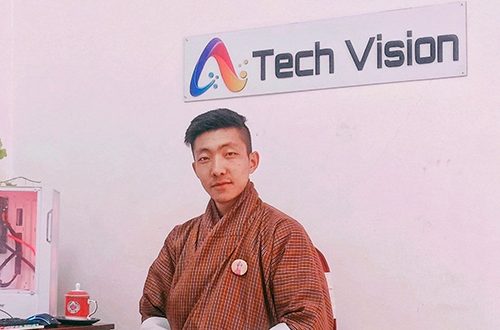
In a classroom where some students followed lessons with ease while others quietly fell behind, 24-year-old former art teacher Chador Wangchuk noticed a simple but persistent gap: not every child learns the same way.
He said, “I have been an art teacher for over a year, and what I noticed among my students was that there are children who have different abilities and capabilities of learning. Now with changing times, some learn better in the traditional way while a handful others learn better with visual arts.”
He said he believes that the power of tech can be used to bring immense positive impacts, and this led the to establish Tech Vision, an edutech startup that uses artificial intelligence (AI) to create illustrated learning materials for children who struggle with text-heavy methods.
“In every classroom, there are students who understand better through visuals rather than words,” Chador said. “We are trying to use AI to make learning more accessible for them.”
The initiative comes at a time when Bhutan’s education sector is placing increasing emphasis on inclusive learning. According to the Ministry of Education and Skills Development, expanding equitable access and improving learning outcomes in early education remain key priorities, particularly in ECCDs and primary schools.
Tech Vision’s approach is simple: combine storytelling, illustration, and AI tools to produce children’s books that translate concepts into visual narratives. The materials are currently used in ECCDs and primary schools in Thimphu and Punakha.
Teachers who have used the books say they are seeing a difference in engagement.
“One of my students who usually struggles to follow written lessons was much more responsive when using illustrated material,” said an ECCD facilitator in Thimphu. “The child was more attentive and willing to participate.”
Globally, such approaches are gaining ground. Organizations like UNESCO have highlighted the growing role of AI and digital tools in making education more adaptive and inclusive, especially for diverse learning needs.
Over the past year, Tech Vision has distributed its books across several schools, receiving what Chador describes as “encouraging” feedback from both teachers and students. Children, he said, appear more immersed and engaged when lessons are delivered visually.
Still, the path is not without challenges. Producing quality AI-assisted content requires continuous research and adaptation, while scaling access beyond urban schools remains a hurdle. There are also broader questions around how quickly schools can integrate such tools into everyday teaching.
Despite this, the startup is pushing ahead. In addition to books, Tech Vision is exploring app-based learning tools aimed at addressing learning gaps more interactively.
The long-term goal is to expand across all dzongkhags and develop materials that also cater to children with physical and learning disabilities.
For Chador, the idea remains rooted in a simple classroom reality.
“Technology offers us a way to reach students who are otherwise left behind,” he said. “If we can make learning easier for them, even in a small way, that is progress.”