The Bhutanese Leading the way.
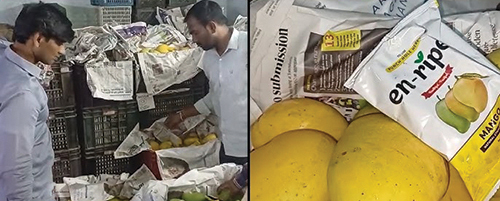
As the mango season begins to flood regional markets, a massive crackdown on artificially ripened fruit in India has sparked new concerns over the safety of Bhutan’s imported produce.
A recent news from NDTV showed a huge crackdown of 200 kg of artificially ripened mangoes in Hyderabad, India.
According to the article, the police arrested a 32-year-old fruit trader, Kunal Nokatwale, after a raid near Balkishan Mandir in Chudi Bazar on 3rd April.
The trader claimed that he used a “Diamond Ripe- Ethylene Ripener” to ripen mangoes quickly before selling them in the market. During the raid, officers seized four packets of the chemical, 25 loose sachets and around 200 kg of mangoes.
The article further mentions that the food safety rules only allow five sachets of ethylene ripener for every 20 kg of mangoes. However, the trader was allegedly using six sachets for each 20 kg tray, breaching the limit set by the Food Safety and Standards Authority of India (FSSAI).
The case has then been registered under multiple sections of food adulteration, cheating and endangering public health, stated the NDTV article.
The case comes to light especially since the mango season begins as mangoes in tremendous numbers arrive in Hyderabad.
“With the onset of summer, the mango has begun to flood the markets. However, citizens must not overlook the deadly danger lurking behind these mouth-watering fruits. Driven by a greed for profit, some unscrupulous traders are risking public lives,” said V.C Sajjanar, Hyderabad Police Commissioner.
“Instead of allowing mangoes to ripen naturally, they are being artificially ripened using Calcium Carbide and other hazardous chemicals. Purchasing fruits solely because they look shiny and golden on roadside stalls is essentially inviting illness into your home,” he further wrote on X.
The sources mention that ripened mangoes usually have uneven color. Chemically ripened mangoes look uniformly yellow, have a strong chemical odour and a strange taste.
Doctors warn that these artificially ripened fruits can cause throat irritation, nausea, vomiting, stomach pain and diarrhoea in the short term, while repeated consumption may even affect the nervous system and breathing in the longer run.
In a new press release, FSSAI has ordered strict enforcement across states to intensify action against illegal fruit ripening agents such as the use of calcium carbide for artificial ripening of fruits such as mangoes, bananas, and papayas.
As Bhutan is a huge importer of fruits, vegetables and other manufactured consumer goods mainly from India, this raises concerns over food safety and public health.
In other news, according to news sources such as the NDTV, Economic Times, and CNBC, there have been crackdowns of other products such as adulterated oils, fake ghee, synthetic milk and even fake Sensodyne toothpaste.
Therefore, in light of these increasingly chemically altered products, the role of the Bhutan Food and Drug Authority (BFDA) becomes increasingly important and apparent in monitoring and regulating food safety standards for internationally imported consumer goods.
The Bhutanese has sent questions to the BFDA regarding this issue of which they responded that they are currently preoccupied with other priorities.
The paper will be following up in the next issue regarding specific procedures, compliance measures, and actions adopted and taken by the BFDA.