The Bhutanese Leading the way.
West Bengal is arguably the most important Indian state for Bhutan, as the majority of Bhutan’s trade and transportation passes through it, and any changes in the state tend to have a major impact on Bhutan.
The recent state elections have led to a change in the state government with the 15-year-reign of the Trinamool Congress (TMC) under Mamata Banerjee giving way to the Bharatiya Janata Party (BJP) under the new Chief Minister Suvendu Adhikari.
“Our exporters are probably happier than the West Bengal residents with the election results,” said Tshering Yeshi, the General Secretary of the Bhutan Exporter’s Association (BEA).
The reason for the happiness is hope among Bhutanese traders that the illegal Suvidha tax or charge for queuing on Bhutanese trucks headed to Bangladesh, imposed by the TMC government from 2022 onwards, may now be lifted.
Suvidha charge is seen as being in violation of Article 1 of the Agreement on Trade, Commerce and Transit between the Royal Government of Bhutan (RgoB) and the Government of India (GoI) of 12th November 2016, which states, ‘There shall, as heretofore, be free trade and commerce between the territories of the RGoB and GoI.’
It also violates Article 5, which states, ‘All exports of Bhutan to and from countries other than India will be free from and not subject to customs duties and trade restrictions of the GoI.’
Tshering Yeshi said the association is waiting for the new West Bengal government to be formally in place before taking up the issue further.
Tshering said he is hopeful as the new WB government has already issued a notification asking that illegal tolls not be collected on highways and roads, although this does not impact the Bhutanese trucks going to Bangladesh.
Tshering said that more than the BEA, it should be the Ministry of Foreign Affairs and External Trade (MoFAET) that should take up the issue with the West Bengal government at the right time as the government knows about the issue very well since the last 3 to 4 years.
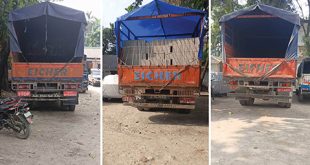
Currently, Bhutanese trucks pay mostly between Nu 2,050 to Nu 6,000 per truck depending on its size at checkpoints in Changrabandha since 2022 and in Fulbari (since June 2025). The charge can, however, go as high as Nu 12,500 per truck for higher value items.
Tshering said that the Suvidha tax has badly impacted the boulder and aggregate export business to Bangladesh, not only reducing it in size but also sharply harming its profit margin.
He said while Indian and Bhutanese pay the same Suvidha rates Bhutanese trucks have to travel 166 km to reach the Bangladesh border while it is around 5 km for Indian competitors.
Tshering said another issue is that Bhutanese six wheeler trucks do not overload and carry 11 metric tons (MT) while in the same truck in India the Indian suppliers carry around 35 MT. He said this means Bhutanese are paying as much as Nu 126 per MT and Indians are paying Nu 33 per MT in transportation charges.
These days 360 to 400 trucks go to Changrabandha and Fulbari in a day post Suvidha while in the past it was around 530 to 540 trucks in a day with better profit margins.
Before Suvidha, the profit margin was around Nu 150 per MT, but now it is Nu 30 to 40 per MT.
The hike in fuel prices has also hit the business as while transporters earlier paid Nu 950 to Nu 1000 it is now around 1150.
Tshering said the boulder business is a volume-driven game and pricing makes all the difference.
He said the increase in land lease rates for stockyards under Phuentsholing Thromde from around Nu 4,600 per year for one acre to Nu 345,000 is a big hike.
Suvidha had been put in place by the TMC after it claimed it was running dry without adequate funds from the Central Government and TMC itself was running many schemes.
The BEA said they are also impacted by an unrealistic Minimum Floor Price set by the DGM based on which the Export Royalty and Mineral Rent is charged.
Also, the recent decision by the Indian government to permit extractions of stones from rivers adjacent to Phuentsholing and Samtse have impacted Bhutanese exporters as numerous crusher plants have emerged on the Indian side giving intense price competition.
The Suvidha portal is also reportedly prone to malfunction and leading to failed transactions, but there is no provision for refunds in both Fulbari and Changrabandha, and in the case of Changrabandha, the slot booking there is controlled entirely by individual Indian transporters utilizing their personal IDs on behalf of Bhutanese exporters leading to unfair allocation of slots.
One way out is to transport the boulders by train to Bangladesh, but for that, Bhutan would need permission from India to use the rail routes to take the stones deeper into Bangladesh.
The new Chief Minister visited Siliguri recently.
A source in the government said the Consul General in Kolkata has not yet met the new Chief Minister as the government is not fully set up, and an appointment will be sought once everything is in place. One of the top priorities will be to discuss for a solution to the Suvidha issue as till now the Central Government had essentially said the matter is out of its hands as the TMC State government was not cooperating.
In October 2025 after heavy rainfall hit Bhutan and North Bengal causing floods and slides in both places, Mamata Banerjee placed the blame on Bhutan and asked for compensation from Bhutan and the institution of an Indo-Bhutan River Commission with West Bengal representation.
However, unknown to Mamata, there is detailed information sharing between both Bhutan and India on river levels with even Indian officials sitting in Bhutan sharing the data with their counterparts in India.
In what is hoped will be a positive development, the new West Bengal government has handed over some highways to the center or the National Highway Authority of India, and one of them is the Hashimara-Jaigaon stretch to Bhutan. It is hoped there will be better maintenance and more resources here.
It is also hoped that cross-border ills like drug smuggling, counterfeit currency and illegal trade in wildlife can be better curbed with a new government, as BJP is known to be stronger on national and border security. It is no secret that the majority of drugs coming into Bhutan is from Jaigaon where some connected people are behind the operation including trade in wildlife. These connected people may no longer enjoy the old ‘protections’.
While there is positivity and hope from Bhutanese traders and officials with the new government in West Bengal, there may be a couple of other tricky issues too.
A source said, “With the same governments in both Delhi and West Bengal, things can go really well, and if there are issues then things can go really bad too.”
The source said one advantage of different governments at the central and state level was seen in 2017 when Bhutan moved to open the second entry gate into Bhutan (not exit) called the Thuenlam Gate near Bowbazar. It has been understood that the Consul General of India and the SSB (which comes under the center) were not enthusiastic about it, but the district administration and police under the West Bengal government supported and allowed it.
The new state government has already handed over large tracts of land at the border to complete its fence with Bangladesh. While this does not affect Bhutan in any way, the only concern is if the Bhutan-West Bengal border is overly militarized or securitized, which would increase harassment of Bhutanese and Indians along the border and for those coming in or going out.
In the post pandemic period, the border between the two countries has become more formalized with the SSB moving right next to the Phuentsholing gate and even customs that come under the central government too started demanding more paperwork for exports into India such as agricultural products. An overly formalized border regime could hamper trade and movement of people.
Another potentially sensitive issue is that of beef or buffalo meat. Bhutan imports a significant quanity of beef or buffalo meat from West Bengal or via West Bengal, and with the bovine meat being a sensitive political issue, there is already friction there within people in the state and this in the future could hamper supply to Bhutan.
This is not an unfounded fear as in 2016 just before the West Bengal poll period the Chief Secretary of West Bengal had informed the Bhutanese Consul General that the West Bengal government does not want to export beef from Jaigaon in West Bengal to Bhutan. The issue was resolved without formal enforcement.
The MoFAET and also the Home Ministry will have its work cut out in the coming days and both will have to navigate the ties skillfully with the new leadership in Kolkata.