The Bhutanese Leading the way.
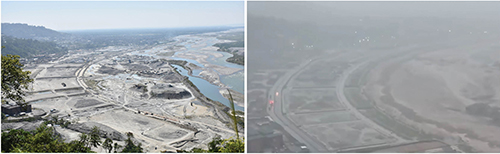
After the recent flooding on the Amochu river there are concerns being expressed on the safety and viability of the the Phuentsholing Township Development Project (PTDP) with climate change expected to make floods worse and more unpredictable. There were some online even asking for the project to be abandoned.
However, according to the PTDP, the area under the present scope of was unaffected by the recent flooding on 5th October 2025. The project said that while flood situations in past years were effectively mitigated, the 2025 flood was particularly larger and more severe, comparable to, or possibly exceeding, the 2016 flood.
Even under these extreme conditions, the functional design of the PTDP river protection structures proved effective as intended. The lower walkway, which by design serves a dual purpose as the first level of flood protection during severe floods and as a pedestrian walkway during normal conditions, experienced some localized overflow. This resulted in debris accumulation and minor damage to bollards and cow chains installed along certain stretches. PTDP stated that this flooding behavior aligns with the design intent, and the affected areas will be cleared and the damaged amenities restored for regular use.
PTDP stated that the township’s current flood protection system was able to withstand the volume of water during the recent flood. The primary flood protection system, comprising the 4.5 km-long and 14.9 meter-high river training wall, including both lower and upper walkways, successfully endured the flood.
Preliminary observations indicated that the flood volume was slightly higher than the 2016 flood, estimated between 2,300 and 3,000 cubic meters per second, corresponding to a 1-in-10-year flood as defined in the hydrological design parameters for the Amochhu Basin.
The PTDP structures are engineered to withstand flood risks of up to 7,100 cubic meters per second, approximately 2.5 times greater than the recent flood volume. PTDP stated that the core river training structure exhibited no signs of deformation or structural distress, confirming its capacity to endure significant hydraulic pressure and high-water levels.
Regarding the township’s capacity to handle flood events, PTDP stated that the infrastructure is designed to accommodate varying magnitudes. Annual increases in river volume during the rainy season are estimated to remain below 2,000 cubic meters per second, which is not expected to significantly impact the mitigation measures. For a 1-in-10-year flood, the system can accommodate a discharge of 2,558 cubic meters per second, which remains below the lower walkway level. For a 1-in-100-year flood, the design capacity of 7,100 cubic meters per second can be contained within a 300-meter-wide trained channel, with the lower walkway intentionally designed to be inundated to protect the structural core.
PTDP stated that the long-term performance and flood resilience of the structures depend on regular maintenance of riverbed levels from upstream near Amochhu Bridge to the international border, and on controlled human activity within at least 300 meters of the current protection wall. Dredging operations must be carefully regulated and monitored to ensure compliance with the technical specifications of the PTDP design.
Regarding vulnerable areas, PTDP stated that there were no critical areas within the township at particular risk during this flood. Some sediment deposition occurred along the lower walkway upstream of Open Outfall 02, where minor damage to installed amenities was observed. This section, located along a major river bend, was deliberately engineered to absorb high flood impacts, with the vertical RCC wall and lower-level amenities designed as sacrificial elements to protect the core urban area.
The project has been coordinating with national disaster management agencies to enhance preparedness and early warning systems. PTDP entered a Memorandum of Understanding with NCHM in May 2021 to install Flood Early Warning Systems along the Amochhu Basin, with a total allocation of Nu 28 million, of which approximately 50 percent has been released.
The installation is now in an advanced stage, and NCHM will also oversee community awareness and preparedness activities. The project will further integrate and coordinate with local and national disaster management systems.
Following the flood, PTDP stated that there are no immediate plans to update the township’s flood resilience standards, as the existing infrastructure performed according to design parameters. However, the long-term sustainability depends on maintaining the riverbed at its designated level and preventing uncontrolled dredging upstream, with continued support from the Royal Government and relevant authorities.
PTDP stated that community concerns and safety are integral to the planning process. The performance of the infrastructure during the recent flood provided strong assurance of its reliability, demonstrating that the project effectively protected lives and property. Without the flood mitigation measures, the Amochhu LAP area, the workshop area with permanent structures, and other private and public properties would have been significantly affected.