The Bhutanese Leading the way.
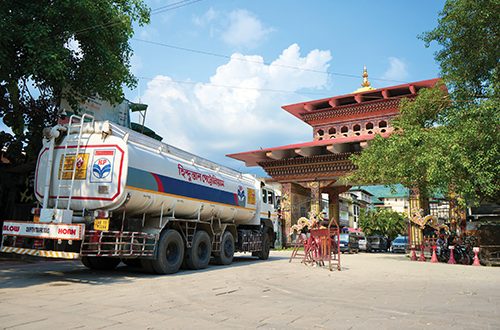
Nu 2.5 bn given by GoI for ESP to go back to GoI via fuel price support
As of 21st May 2026, the government has spent Nu 1.531 billion (bn) in fuel price support of which Nu 1.469 bn has been spent for diesel and Nu 62 million (mn) for petrol.
The government has allocated Nu 2.5 bn from the Economic Stimulus Program (ESP) to the National Fuel Price Smoothening Framework (NFPSF).
This was mobilized by reallocating funds from many ESP investment areas, specifically from funds that had been allocated but not yet disbursed or committed.
The biggest cut is the Nu 1.5 bn for chiwog road blacktopping for large chiwogs. Bhutan has 1,044 chiwogs and so Nu 1.5 bn had been kept to blacktop roads to bigger chiwogs or those that need it due to remoteness etc.
This was initially supposed to be the Home Ownership Loan but the amount was felt to be too small and ineffective for that.
Here the Lhengye Zhungtshog, during its 83rd Session held on March 30, 2026, took an active policy decision not to pursue the scheme for the time being. The funds have therefore been redirected to the fuel smoothening framework, where the impact will be broader and more immediate.
The other big cut is Nu 500 mn from the Agriculture and Livestock Development price guarantee scheme whereby the government would buy certain crops and livestock products from farmers to support them.
Nu 206.94 mn is also being reallocated from the Concessional Credit Loan (CCL) scheme under BDBL.
Tourism Development will see a cut of Nu. 112.585 mn, Cottage and Small Industries will see Nu. 68.51 mn cut, Creative Industry Development fund will be cut by Nu. 39.30 mn and Youth Employment, Education and Training will see a Nu. 72.65 mn cut.
“Since these funds had not yet been disbursed or committed, ongoing program activities under each of these investment areas will not be affected,” said an official.
The Nu. 2.5 bn has been fully sourced from within the ESP, and no reallocation from other budget heads has been made at this stage.
However, should fuel price pressures persist or intensify, the government said it is prepared to consider two options which are rationalizing expenditure in lower-priority areas to create fiscal space, or activating Targeted support under Phase II of the NFPSF. Any such decision will be guided by the prevailing macroeconomic conditions and fiscal sustainability considerations.
Phase II implementation will depend on the price of fuel as any major increases will see a faster implementation. Here the use of pool vehicle will not be allowed and fuel support may be given to only critical areas like public transport, goods carriers etc.
The government said this strategic reallocation is in line with the ESP’s core objective of ensuring macroeconomic stability as fuel price volatility directly affects transport costs and the broader cost of living, and the framework is designed to cushion the economy from the impact of global price shocks.
The paper has learnt Nepal Oil Corporation (NOC) has formed a new committee to discuss the new General Supply Agreement (GSA) with India as the current agreement runs out on 31st March 2027.
A senior NOC official told this paper that one agenda the Nepal side will raise with its supplier and counterpart Indian Oil Corporation Limited (IOCL) is to give the complete breakdown of the costs in the new agreement.
Unlike Bhutan, Nepal gets a more comprehensive break up of its fuel costs from IOCL with only the Marketing Cost not mentioned. Nepal wants to know this part as this is where the big cost increase is hidden.
The paper asked the Bhutan government on if there will be an outreach to GoI to bring down prices or to make some other arrangement for our fiscal stability if high prices continue.
The government in a written reply said, “The Royal Government remains fully committed to ensuring fuel price stability and safeguarding the cost of living of our people. On the question of outreach to the Government of India, it is important to note that fuel price pressures are a global phenomenon and India itself is navigating the same challenging international price environment.”
“As a longstanding and trusted strategic partner, the Government of India has consistently stood by Bhutan, and the Royal Government will continue to engage with India through appropriate diplomatic and institutional channels on matters of mutual concern, including energy security and economic stability. Any formal position on government-to-government arrangements of this nature would appropriately be communicated by the Government,” the government added.
The government said that from an operational standpoint, over the past two weeks, diesel prices at source have begun to ease, which has correspondingly reduced the quantum of price support for Diesel being provided by the RGOB.
“The Royal Government is closely monitoring whether this downward trend is sustained through the next fuel pricing cycle, expected by the end of the month, before considering any further measures.”
The government said the Ministry of Industry, Commerce and Employment remains fully engaged on all supply and distribution matters and continues active technical discussions with the relevant Public Sector Undertakings and counterparts to ensure uninterrupted petroleum supply and the overall stability of fuel distribution across the country.
This paper asked if there will be an attempt to get a price breakdown too.
The government said it will not be attempting to secure a further internal price breakdown, as it has already been confirmed that no export duty is imposed on POL products exported from India to Bhutan.
“What matters most is that Bhutan continues to receive an uninterrupted fuel supply at fair terms, which India has fully guaranteed despite facing its own supply chain challenges.”
“Furthermore, our technical agencies and domestic fuel dealers remain in regular contact with the Indian Oil Marketing Companies (OMCs). These engagements confirm that the current elevated prices are driven entirely by intense volatility in international oil markets—a macroeconomic challenge affecting countries worldwide, rather than a result of Bhutan’s specific supply arrangements.”
The government said it will continue to monitor the situation closely to protect the interests of our people.
Between March 22 and May 15, 2026, the Government provided diesel price support across five review cycles. On March 16, the diesel price stopped at Nu. 70.18 per litre with no support provided.
By March 22, as the price rose to Nu. 108.17, a support of Nu. 16.00 per litre was introduced to keep the consumer price at Nu. 98.31.
The situation worsened significantly by April 2, when the price surged to Nu. 174.13, requiring the support of Nu. 75.82 per litre.
The peak was reached on April 17, when the price hit Nu. 199.66, necessitating the highest support of Nu. 101.35 per litre to maintain the consumer price at Nu. 98.31.
By May 2, as global prices eased somewhat, the price came down to Nu. 139.34, and the support was reduced to Nu. 41.03 per litre.
Now it’s Nu. 23 per liter support for diesel.