The Bhutanese Leading the way.
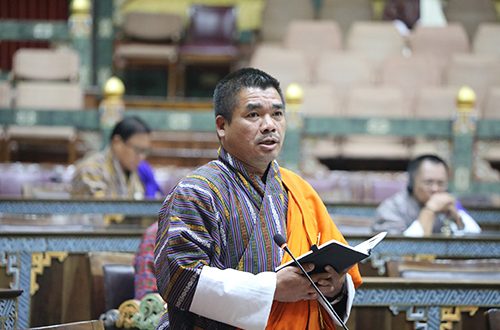
Member of Parliament (MP) of the Radhi-Sakteng constituency, Tashi Tenzin, raised concerns over the recurring Yudhiri landslide along the Trashigang–Phongmey Dzongkhag Road, questioning the government on long-term mitigation plans for the vulnerable area.
According to the MP, the Yudhiri area remains highly prone to recurring landslides, particularly during the monsoon season, posing serious threats to public safety, agricultural land, the Trashigang–Phongmey road, the Bailey bridge, and the transportation of essential goods and services to Phongmey and Sakteng Gewogs.
The MP stated that repeated road blockages continue to disrupt critical public services and institutions, including a Central School, a Primary Boarding School, a Primary Health Center (PHC), two Thimphu–Phongmey bus services, and the Sakteng Wildlife Sanctuary office. The disruptions also affect residents of both gewogs who rely on the road for mobility and access to essential services.
The MP said seasonal road closures have persisted for decades, severely affecting livelihoods and isolating communities while increasing repair and maintenance costs. He added that changing climate patterns and increasingly intense rainfall in recent years have further aggravated the situation, leading to more frequent and severe reactivation of the landslide area.
The MP also noted that although interventions from the Department of Surface Transport had been requested and several site visits were conducted by technical and management teams, including a visit by the Secretary of MoIT in April 2025, no visible long-term mitigation measures beyond routine monsoon maintenance have been implemented so far.
In response, the MoIT minister Chandra Bdr Gurung acknowledged the long-standing issue and stated that geotechnical assessments of the Yudhiri slope instability had been carried out on several occasions over the past decades.
The ministry said studies had also explored the possibility of realigning the road. However, no suitable bridge location could be identified either upstream or downstream of the existing bridge site.
According to the MoIT, frequent flooding along the Yudhiri stream and the steep, fragile terrain within the gorge have significantly contributed to slope instability on both riverbanks. Assessments further revealed that the slopes surrounding the bridge area remain highly saturated due to elevated groundwater conditions, which worsen during the monsoon season and trigger slope movement.
The ministry identified seepage water as one of the primary causes of instability and said a series of subsurface drainage measures have been recommended as part of a long-term slope stabilization strategy.
The proposed interventions are expected to begin in phases from the 2026–2027 financial year.
The ministry added that technical teams would continue monitoring the site to assess the effectiveness of the drainage system and recommend additional structural stabilization measures if required based on evolving geotechnical conditions.