The Bhutanese Leading the way.
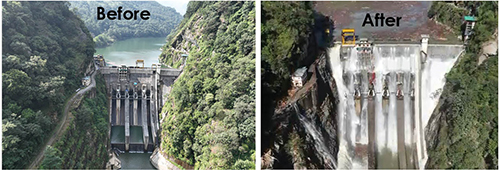
As overtopping continues on the 1,020 MW Tala Dam, which is Bhutan’s cash cow and a key source of revenue, there are now serious concerns on the dam stability and its equipment.
How the overtopping happened
On 4th October Saturday night, as heavy rains lashed across Bhutan, a Tala dam official said they noted that water levels were rising and so two gates were slightly opened from 1 am till 5 am, but at 6.13 AM in the morning of 5th October, the power supply to the Tala Dam which comes from two 11 KV lines from Chukha project was disrupted.
By then, of the five gates, gate two had been opened up by 13.15 meters height and gate three had been opened by two meters.
The official said the heavy rains, winds and thunder had tripped a 220 KV line from Chuka which led to the shutdown of Chukha, and so the gates had no power.
The official said that efforts were then being made to start the back up diesel generators to supply power which takes 10 to 15 minutes, but around the same time, there was a flash flood in the two streams that are after the Chukha Dam and before Tala dam along with heavy rains creating additional streams in the area.
The official said the flash flood from the two streams Lubichu and Tichhalumchu came suddenly and brought a huge volume of water suddenly that overwhelmed the dam, and the overtopping happened before the diesel generators could supply power to open the gates.
The official said that they had been monitoring the water level from the Chukha dam, and accordingly adjusting the Tala dam, but they did not account for the flashflood from these two streams, and what made matters worse was the failure of power from the Chukha dam.
Before power could be supplied to the Tala dam’s three power packs and hydraulic systems that control the five spillway gates, the overtopping happened which meant water not only went over the dam but also into the power packs damaging the electronics that controlled the gate hydraulics and the water and debris also damaged the hydraulic pipes.
This meant that even if power was restored, the entire power and hydraulic system to open the gates were destroyed. The two gates which has been partially opened on Sunday morning also closed by Sunday night.
The official said the Tala dam can handle heavy river flow, but the flash flood came as a surprise.
The water flow had surged from less than 200 cumecs by 4 AM to about 1,260 cumecs at Chukha dam by 11 AM on 5th October, leading to dam overtopping around 7 AM.
Tala dam not designed for overtopping
The major concern is that the Tala dam is not designed for overtopping.
A hydropower expert the reporter spoke to said that water was never meant to overflow over the Tala dam, and it is, in fact remarkable, that the dam has held up despite almost a week of water overtopping it.
The expert said the danger is that even when the radial gates are opened, the water flows away in a canal like structure and lands a good distance away from the foot of the dam.
However, in an overtopping the water directly hits the very base of the dam which can lead to scouring of the base, and it over time can impact the very stability of the dam.
The expert said the scouring can happen on the very face of the dam itself.
A video also shows water not only going over the dam but also the structures near the dam like the road and the side walls downstream of the dam, and so their stability needs to be checked too.
The expert said that the only saving grace is that this did not happen in the peak monsoon, and is happening towards the end of the monsoon.
Once the overtopping can be stopped, the Druk Green Power Corporation (DGPC) will be engaging experts to check the dam stability.
Current status
As of friday, Tala dam was generating with its five units, with one unit on standby so as to let as much water out as possible and water is also being sent out though the two silt gates which is 700 meters downstream of the dam.
With the power pack and hydraulic systems damaged, there is no hope of opening any of the main five spilly way gates right now.
As of Friday evening, the overtopping was still happening on and off, and it might take two more days till it stops though it may take longer if there are rains.
All six units are not being run because the fear is that with debris piled near the intake tunnel for the head race tunnel air could get into the HRT which would be disastrous.
The inflow is 175 cumecs at Chukha dam. Two excavators have been engaged to clear the logs and debris to make access to the dam top and Gate Operating Chambers (GoC) for Silt Flushing Tunnel (SFT). On getting access to the dam top, an assessment of the power pack and hydraulic cylinders of the hoisting mechanism for the radial gates will be made. Experts for the power pack and hydraulic cylinders for the radial gates are being mobilized.
Experts’ views and questions
The expert questioned that even with the power knocked out, how come the radial gates could not be opened as the pressurized oil in the hydraulic system can be used to open the gates?
The expert said to test the claims of the Tala staff that a flashflood caused it the water flow details at Chukha and before Tala dam need to be checked. The expert said the overtopping is a major lapse.
With such a major issue, some basic questions need to be asked.
A source, who requested anonymity, said that the failure to act on time to open the water discharge gates is gross negligence as five gates are designed to operate based on practical silt deposits, logs displacement.
The source said that if power supply fails, then to address worst situation, dedicated Diesel Generators (DG) are in place where power supply changeover is configured to happen automatically. The source said that every week, the DG set needs to be tested to serve emergency. It would be gross negligence if there was no proper maintenance of the DG set.
The source said that if Tala dam overtopped then the same should have happened to Chuka too as they are on the same river and not very far from each other, and Chukha dam has only 4 gates with smaller discharge capacity.
The source alleged that the overall restoration and generation opportunity lost due to it will likely cost billions.
The source said the power pack and hydraulic system are likely completely destroyed and the dam structure would now be unstable.
The source said that the shutting of the gates would also mean a lot of accumulation of
sand, boulder, debris and logs in the 92 meter high dam.
On the explanation given about that a surprise flashflood overwhelmed Tala Dam the source said, “We have thousands of streams and glacier lakes up stream of the Dam which is designed to evacuate all the total discharge with a safety margin as five discharge gates are designed and simulated to evacuate the total up stream catchment discharge. All the operating principles are in place to operate the Dam to prevent overtopping. Overtopping itself is the biggest failure and gross negligence.”
The source said that there needs to be an investigation to see if the people who were supposed to be there were actually there even if the register shows someone was present. The source also said that the DG maintenance records need to be checked as it is supposed to test run every week to check readiness.
The source said that Tala Dam restoration will take a long time, and it is now a complex situation.
According to the source, the 6 turbines would be more eroded as sand could not escape from the main gates, the power pack and hydraulic system of 5 gates need to be replaced, the gates need to be replaced and debris needs to be removed behind the dam.
DGPC MD clarifies
The DGPC MD, Dasho Chhewang Rinzin, said that around Friday evening, they were able to open the overflow gate groove at dam top (different from 5 main gates) to allow excess water to flow.
The effort is also own to get the Trash clearing machine in front of the intake tunnel for the power station.
The MD said the aim is to bring down the water level in a couple of days. He said while there was a flash flood and it definitely contributed its role is being analyzed. He said everything happened at around the same time with the torrential rains.
When asked about human error, the DGPC MD said, “We can’t find anything to link to human error but a detailed analysis will need to be done. Currently restoration is our main priority.”
Dasho said that on the night the grid connectivity kept going on and off due to the rains. He said the DG set was started but by then they had to evacuate.
When asked if the reservoir levels were kept too high, the MD said they were normal for October. And on if the overtopping would affect the base of the dam, he said, “We are going to have to check that as soon as we can reach it in one to two days.” He said currently there are no concerns on dam stability but they would get it checked.
Dasho Chhewang Rinzin said that for the turbines, there will not be a major difference as the same sediment in the flood water is used. He said the normal annual maintenance will be done as far as the power house and generating equipment are concerned as done every winter.
On the power pack and hydraulic systems, Dasho said they need to do an assessment when they get access and most probably some of them have to be replaced.
He said they don’t think the five gates need to be replaced but they first need to finish the assessment.
What DGPC needs to check
The assessment by the DGPC will need to check how the DG system was used, how the gates performed like gate seal damage, silt or log blockage that may slow gate movement.
It will need to check the logs and remote commands available to check if operators followed the flood operation table, and how they coordinated with upstream Chukha as required. The Tala Operation and Maintenance (O&M) manual requires coordination with Chukha confluence gauge levels and upstream plants during monsoon.
The O&M manual contains a flood gate-opening table and explicit procedures for staged or gradual opening and for how many gates to open at different discharge bands. It also requires coordination with upstream plants and confluence gauges. The DGPC needs to check if this happened.
Two 1250 kVA DG sets are installed (11 kV) specifically to meet blackout or emergency requirements. The manual prescribes running DGs twice weekly and periodic maintenance. That makes DG readiness an explicit operational requirement. There needs to be a full test and overhaul of DG sets and automatic transfer systems.
Event logging is important to check for alarms and Sequence-of-Events (SOE) which are crucial evidence to determine timing and cause of actions pr inactions during the event.
For any review or investigation, DGPC will have to freeze or secure all digital logs and preserve physical evidence (SOE, HMI screenshots, DG digital logs, maintenance files). The manual requires preserving evidence.
There will need to be an independent technical audit and structural safety inspection to check for foundation, seepage and drainage pumps.
The latest update as of Sunday evening is that overtopping of the Tala Dam has stopped and now there will be a damage assessment.