The Bhutanese Leading the way.

While Bhutan may have done mega hydro projects in the past, Bhutanese contractors, engineers and technical staff have largely been bystanders doing some minor works, as foreign construction companies do the main works and develop their capacity in the process.
There have been instances in the past, where foreign contractors coming as sub-contractors in earlier Bhutan hydro projects went on to be the main contractors as they got experience in Bhutan.
However, that is now starting to change with the 54 MW Burgangchu Project in Nangkhor, Zhemgang which will be completed in March 2026 and the 32 MW Yungichhu Project in Medtsho, Lhuentse to be completed by February 2026, where there has been a lot of Bhutanese involvement at all levels, and thus capacity development.
Both the projects are implemented by the Druk Green Power Corporation (DGPC). The projects are done by Druk Hydro Energy Limited (DHyE) which is a 100 percent subsidiary company of DGPC to do projects of 150 MW and below.
The DGPC Managing Director, Dasho Chhewang Rinzin, said, “In terms of building our capacity these projects have the biggest impact as whether you do a small project or a large project, it is similar as there is an intake structure which is normally a dam, the head race tunnel and the power house.”
He said the civil works are entirely done by local contractors. The SCADA system that controls the electro-mechanical equipment is by Bhutan Automation and Engineering which is also a subsidiary of DGPC.
The hydro-mechanical works are by Bhutan Hydropower Services, another subsidiary of DGPC. Only the electro-mechanical equipment is provided by others, but here, Bhutanese teams are providing the erection and commissioning support.
“Therefore, there is engagement of Bhutanese in all aspects of the project, including design and engineering that is being done in-house with some reviews from outside,” said the DGPC MD.
He also said, “It has built our capacity and confidence and we are now taking on larger projects like 90 MW Jomori. In the next phase we will take on even larger projects.”
“This has been the real building block to gain expertise and experience in DGPC and to grow our private sector. We intend to work harder and invest at building our capacity further,” the DGPC MD added.
A new technology in both the projects is that they are automated through a SCADA system with possibilities for remote operation.
“Actually, we should be able to remotely operate but we will need maintenance people, and so we are considering 4-5 people for each project as these are remote areas and so in an emergency, we need people there,” said Dasho Chhewang.

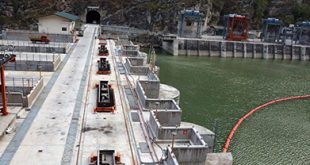
The switchyard area and powerhouse of Burgangchhu
The MD said that while Burgangchu is 54 MW and Yungichhu is 32 MW and while at the national level, the installed capacities may appear small, but at the local level, they will help stabilize the grid and ensure reliable power supply to the nearby dzongkhags.
The 54 MW Burgangchu Project was delayed from its original completion target of December 2024 due to a combination of challenging geo-technical conditions, design revisions and additional construction requirements.
Difficult ground conditions at key underground structures, the need to modify excavation methods and unexpected geological variations extended construction timelines. Further adjustments to structural layouts, hydro- and electro-mechanical components also contributed to slower progress.
The project is now expected to be completed by March 2026. The project officially commenced on 8th June 2022. It will provide firm winter generation of 18 MW and is supported through a mix of institutional financing and equity investment, and is already stimulating local economic activity and improving infrastructure.
Once operational, it will strengthen grid reliability in the central region, with surplus summer energy potentially available for export.
The run-of-the-river project cost was initially projected at Nu 3.656 billion (bn) but it will be revised for its completion cost. It will produce 260.51 million units of power in a year.
The Burgangchu Hydropower Project is located near Buli village in Nangkor Gewog about 56 km away from Zhemgang town. The intake and powerhouse sites are 5 km and 11 km away respectively from the Nangkor Gewog center.

Inside Burgangchhu power house
The 32 MW Yungichhu Project has been delayed from its original 2025 completion target due to a series of geotechnical challenges, weather-related disruptions and additional construction requirements.
Repeated landslides near the tunnel inlet, unexpected increases in underground excavation lengths, and a flash flood that damaged site facilities and killed 23 people significantly slowed progress.
External factors such as transport disruptions following the collapse of a major bridge and various unplanned works also contributed to the revised schedule.
The project is now expected to be completed by February 2026. It will provide firm winter generation of 8 MW, and like Burgangchu is financed through a combination of institutional loans and equity. It has also stimulated economic activity and improved local infrastructure in the project area.
Once operational, it will enhance grid reliability in the eastern region, with surplus summer energy potentially available for export. The project cost was initially estimated at Nu 3.660 bn and it will produce 157.6 million units of power in a year.
Yungichhu hydropower project is a run-off the river scheme planned across Yungichhu. The project is located near Onngar village in Maedtsho Gewog about 34 km away from Mongar-Lhuentse national highway. Yungichhu is a tributary of Kurichhu which in turn is a tributary of Drangmechhu, the biggest river basin of Bhutan. The catchment area at the intake site is 125 sq km and the river joins another tributary, Wambur at an elevation of about 1176 meters above sea level (masl).
The intake and powerhouse sites are 12 km away from the Gortshom Gewog center.