The Bhutanese Leading the way.
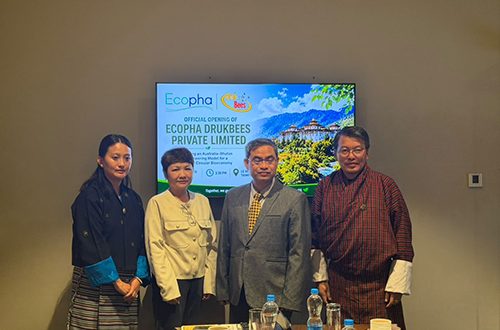
A new era of sustainable technology has arrived in Bhutan with the official opening of Ecopha DrukBees Private Limited. This Foreign Direct Investment (FDI) company establishes a world-class hub for research and model development.
It focuses on creating an integrated, sustainable bioeconomy. The initiative harnesses the power of non-edible, regenerative crops to deliver environmental and economic changes.
At the core of this project is a patent-filed, integrated biorefinery platform. The company describes it as a new industrial paradigm.
The firm stated, “This patent-filed, integrated biorefinery platform represents a new industrial paradigm. By harnessing a non-edible, regenerative crop, we are enabling a fully circular bioeconomy; one that decarbonises aviation, eliminates plastic pollution, and generates carbon credits, all from a single sustainable source”.
This platform merges Sustainable Aviation Fuel (SAF) with PHA bioplastics and full value-chain traceability.
Bhutan was chosen as the ideal home for this research and certification hub due to its environmental stewardship. The nation’s commitment to Gross National Happiness provides a perfect setting to certify this traceable model. This project is not a mass-production site. Instead, it functions as a living demonstration centre.
Every step from plantation to the final product will be meticulously recorded. An extensive AI system will monitor environmental conditions in real time. Sensors and chips will be embedded on every single plant.
The data from Bhutan will serve as a global blueprint. This science-backed framework can be adopted by larger regions like India and Africa. Ecopha is headquartered in Australia and is rapidly building a global ecosystem. It already has ventures in China and is expanding to the United States, Japan, and Indonesia.
Strategic partnerships are already strengthening the project’s local foundation. The company is collaborating with the Ministry of Agriculture and Livestock (MoAL). It also works with Bhutan Airlines, Druk Air, and Bhutan Agro Industries.
These links support farmer engagement and policy alignment. Australia contributes advanced R&D, process engineering, and global market access. Bhutan offers bio-resources, a favourable environment, and policy support.
The project aims to demonstrate full circularity. This includes replacing conventional plastics with biodegradable PHA alternatives. It also focuses on land restoration and biodiversity enhancement. These goals are achieved using Pongamia trees.
These trees are drought-tolerant and suitable for marginal lands. Wilson Ling, CEO and Co-Founder of Ecopha Pvt. Ltd., explained the process.
He said, “It involves the use of non-edible Pongamia oil which can be processed to create Sustainable Aviation Fuel (SAF) and can be added into the jet fuel for airplanes”.
Karma Dorji, the Promoter of Ecopha DrukBees Pvt. Ltd in Bhutan, highlighted the circular nature of the technology.
He noted, “As this uses natural materials, the residue can be used to create biodegradable products, which later naturally biodegrades to feed the new Pongamia trees. Thus, leading to a circular process, enabling lesser carbon emission”. The feedstock strategy is specifically designed to avoid competition with food crops.
The project roadmap is divided into clear phases. Phase one runs through July 2026 and involves site assessment and stakeholder engagement. Phase two starts in August 2026 with nursery development and farmer training. This stage also includes setting up a global tree passport data system. The official first planting day is scheduled for September 2026.
Bhutan’s role in certification is vital for international expansion. Wilson Ling stated, “As Bhutan is a globally recognized carbon negative and a GNH country, it will seek to certify Ecopha products, which will seek to expand sustainable and eco-friendly solutions internationally”.
Karma Dorji clarified that this is currently a long-term vision to check if the model works. He added that more R&D is needed to measure efficacy within Bhutan.
This initiative aligns with growing global mandates for green fuel. As of January 2025, the UK and EU require fuel suppliers to blend at least 2 percent SAF with kerosene. These mandates are expected to rise to 70 percent by 2050.
Bhutan’s data-rich blueprint will help other nations meet these strict targets responsibly. This collaboration places Bhutan at the center of a global movement toward a circular bioeconomy.