The Bhutanese Leading the way.
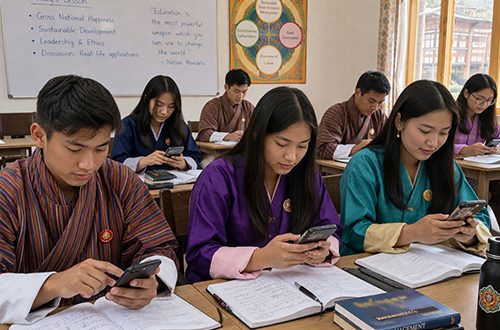
It has been almost five months since the Royal University of Bhutan (RUB) imposed a complete ban on the use of mobile phones during academic hours.
The Office of the Vice Chancellor announced last year that starting 1st October 2025, students across all RUB colleges would no longer be permitted to use their phones during lectures, tutorials, guest sessions or public talks.
Before the new rules were introduced, students often kept their phones with them in class or used them casually between lessons. Under the new policy, all phones must be deposited in designated collection areas before any academic session begins.
They may only be used when a faculty member specifically instructs students to do so for classroom activities, and such permission must be clearly communicated in advance. The directive states, “Phones may be used when expressly permitted by the faculty for classroom-related activities requiring their use.”
Five months after the implementation of the rule, students across RUB colleges are beginning to experience the impact of the policy, with some saying it has improved classroom focus while others believe the rule could be more flexible.
Rinchen Choden, a student from one of the RUB colleges, said the phone ban has helped her concentrate better during classes. She said the restriction has reduced distractions and allowed her to pay more attention to lectures.
“I get distracted less and pay more attention to lessons,” she said, adding that her academic performance has also slightly improved since the rule was implemented.
However, she noted that while she supports the initiative, the policy could have been more flexible. One of the main challenges students face because of the ban is the inability to quickly search for information during class when tasks are assigned.
“I think some tutors should at least allow us to use mobile phones to search when we are given a task in class,” she said.
Without mobile phones, Rinchen said she now relies more on her notebooks to jot down reminders and important points during lectures. While she believes the ban has largely achieved its objective of improving focus among students, she added that limited academic use of phones could still be beneficial.
“It could be improved by allowing limited use of phones for educational purposes, like research or learning apps, so students can still benefit from technology,” she said.
Another student highlighted the difference between a college and a school environment, saying mobile phones can sometimes help students better understand lessons during lectures.
She explained that when students do not fully grasp what a lecturer is explaining and feel hesitant to ask questions, they often use their phones to quickly browse for information and clarify concepts. According to her, this helps students keep up with the lesson and better align with what the lecturer is teaching.
A 19-year-old student from Sherubtse College shared a similar perspective, saying the ban has helped improve his concentration and academic performance.
“At first, I disagreed with the ban because I felt restricted, but now I understand its purpose,” he said.
However, he noted that the absence of mobile phones in class also means students miss out on reminders and quick notifications that they previously relied on through their devices. While acknowledging that the move is intended to benefit students, he suggested that RUB could consider a more balanced approach, allowing limited use of phones for educational purposes or during breaks so students can still access important information when needed.
On social media platforms as well, students shared that mobile phones are not necessarily distractions, stating that they use them as tools for academic purposes.
One of the students wrote that mobile phones are not used only for entertainment but also for dealing with emergencies and managing academic communication. Moreover, they suggested that instead of imposing a complete ban, the university could focus on guiding students on how to use technology responsibly in an academic environment.
This paper also received similar feedback from several students, who said that while the intention behind the ban may be to reduce distractions, not all students misuse their phones during lessons.
They pointed out that students who cause disruptions by misusing their phones should be addressed individually, rather than imposing restrictions on all students, including those who use their devices responsibly for academic purposes.
The majority of the feedback from the students acknowledge the benefits of improved focus but believe that allowing limited academic use of mobile phones could create a more balanced learning environment.
RUB officials, on the other hand, said that the policy aims to restore discipline, reduce distractions, and help students re-engage more meaningfully in classroom learning.