The Bhutanese Leading the way.
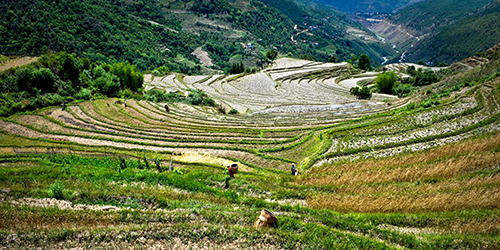
As global headlines warn of a record-breaking “Super El Niño” approaching this summer, the Ministry of Agriculture and Livestock (MoAL) has moved to reassure the nation, stating that while the threat is being monitored, there is currently no cause for alarm for Bhutanese farmers.
Speaking at the 27th Meet-the-Press session yesterday, the officials from MoAL clarified that global climate projections do not always translate directly into local drought or crop failure.
Bhutan’s unique mountainous terrain and its reliance on the south-west monsoon and localized rainfall systems mean the country’s climate often behaves differently than broader regional trends.
Science-led preparedness
The MoAL emphasised that all national advisories are grounded in scientific data from the National Center for Hydrology and Meteorology (NCHM).
While global reports suggest a drier monsoon season, the latest regional outlook actually indicates that parts of South Asia, including Bhutan, may still see normal to above-normal rainfall, though temperatures are expected to rise.
“Our message is clear, we are not complacent, but we are preparing,” the MoAL stated, urging farmers to continue with their normal seasonal preparations while keeping a close eye on official agrometeorology updates.
Strengthening the 13th Five-Year Plan (FYP)
To combat long-term climate variability and potential water scarcity, the MoAL is aggressively mainstreaming disaster-resilient strategies into the 13th FYP. Several key interventions are already underway to protect the 2026 cropping year:
The ministry is constructing 24 new irrigation schemes. Of these, five are complete and seven are currently under construction. Once finished, these 146 kilometres of infrastructure will provide assured irrigation to 5,461 acres of land, benefiting over 3,100 households.
To maximize limited resources, the ministry has already brought more than 1,500 acres under micro-irrigation systems, such as drip and sprinkler technologies.
Support is being scaled up for climate-resilient crop varieties designed to withstand heat, drought, and the pest outbreaks often associated with rising temperatures.
Empowering farmers with data
A central pillar of the government’s response is the strengthening of agrometeorology services. The goal is to provide farmers with location-specific, timely advisories that guide planting schedules and water management decisions in real-time.
The NCHM is expected to release the detailed monsoon outlook for June to September later this month. Until then, the MoAL maintains that Bhutan is well-positioned to handle the upcoming season.
“We will continue to stand with our farmers to ensure a stable and productive cropping season,” the MoAL concluded.