The Bhutanese Leading the way.

The National Assembly (NA) adopted the Amendment to the Reservation on the Convention on the Rights of Persons with Disabilities (CRPD) during the 7th Sitting of the Fourth Parliament.
The CRPD is an international treaty designed to protect and promote the rights of Persons with Disabilities (PWDs), ensuring they can fully enjoy all human rights and fundamental freedoms. The convention was adopted at the United Nations Headquarters in New York on 13th December 2006 and officially came into force on 3rd May 2008.
Bhutan ratified the CRPD during the previous government’s term, placing four reservations on specific articles: 18(1)(a), 18(2), 23(1)(b), 23(1)(c), 27(1)(c), and 29(a)(ii). The ratification, along with the reservations, was submitted to the United Nations on 13th March 2024.
However, 11 countries formally raised objections to these reservations. The reservations are as follows:
Article 18(1)(a), which states, “PWDs have the right to acquire and change a nationality and are not deprived of their nationality arbitrarily or based on disability.” Article 18(2) states, “Children with disabilities shall be registered immediately after birth and shall have the right from birth to a name, the right to acquire a nationality and, as far as possible, the right to know and be cared for by their parents.”
Article 23(1)(b): “The rights of persons with disabilities to decide freely and responsibly on the number and spacing of their children and to have access to age-appropriate information, reproductive and family planning education are recognized, and the means necessary to enable them to exercise these rights are provided.” Article 23(1)(c): “Persons with disabilities, including children, retain their fertility on an equal basis with others.”
Article 27(1)(c): “Ensure that persons with disabilities can exercise their labour and trade union rights on an equal basis with others.”
Article 29(a)(ii): “Protecting the right of persons with disabilities to vote by secret ballot in elections and public referendums without intimidation, and to stand for elections, to effectively hold office and perform all public functions at all levels of government, facilitating the use of assistive and new technologies where appropriate.”
To this, during the First and Second Sittings on the Amendment of Reservation on the CRPD, the Minister of Foreign Affairs and External Trade, said that a multisectoral task force had been formed between June and August this year to review the objections raised by 11 countries. Lyonpo DN Dhungyel added, “The Cabinet approved the amendments to the reservations and the amendments were submitted to the Parliament.”
NA supported the proposal for amendments and referred the convention to the Women, Children, and Youth Committee for further discussions scheduled for the Third Reading.
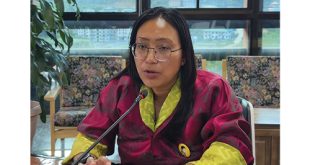
The Third Reading of the Amendment of Reservation on the CRPD was presented by a member of the National Assembly’s Women, Children, and Youth Committee, MP Lhaba Lhaba.
Following a review, the reservations have been revised. MP Lhaba Lhaba noted that 11 countries had mostly objected to Article 18(1)(a) and Article 18(2). To address these concerns, the committee revised the reservations under Article 18 to ensure persons with disabilities enjoy equal rights with others. The MP said, “The revised reservation reads that they shall have the right to acquire and change their nationality without discrimination, and the right to freedom, residence, and to live, in line with Bhutan’s citizenship laws.”
The second objectionable reservation was Article 23(1)(b) and (1)(c), which has now been removed by the committee to address concerns raised by the reviewing countries. The committee noted that the previous reservation contradicted several national laws, including the Marriage Act of Bhutan, as it discriminated against the rights of persons with disabilities; thus, the committee withdrew this reservation.
MP Lhaba Lhaba said, “PWDs shall enjoy equal rights with others, including the right to decide freely about having children, the right to marry, and access to information on reproductive health and family planning.”
For Article 27(1)(c), MP Lhaba Lhaba said the previous reservation has been revised to ensure that PWDs can fully exercise their labour and trade union rights on an equal basis with others. In line with Bhutan’s Workers’ Association, the committee has recommended that persons with disabilities should be given equal opportunities in employment and participation in trade unions.
For Article 29(a)(ii), the reservation has been revised to ensure that persons with disabilities can vote freely and participate in political and public office. The MP said, “They will have the right to vote without influence from others, and assistance will be provided for those who are unable to come forward.”
With all 39 members voting in favor of these three revised reservations, NA adopted the amendments. The adopted amendments will now be sent for review to the National Council, after which it will be submitted to the United Nations.