The Bhutanese Leading the way.

By Pascal Samfat
Literature Review
During the past decade, several countries have rapidly expanded their tourism sectors to drive economic growth. In 2025, international tourism contributed 11.7 trillion USD to the global economy. This has stimulated business opportunities in infrastructure development, restaurants, hotels, and entertainment. Although tourism appears economically viable, the industry is becoming unsustainable since it exceeds the capacity of popular destinations to maintain reliable infrastructure and maintain environmental protection.
Locals who reside in popular tourist destinations have expressed dissent on the consequences of overtourism, especially high congestion, soil erosion in popular nature destinations, water scarcity, higher accommodation costs for hotels/housing purchase, and tourist phobia. Japan is a popular tourist destination which is experiencing overtourism. The influx of 42.7 million international tourists to Japan in 2025 has created severe local dissatisfaction relating to excessive littering, overcrowding at popular tourist destinations, and increased air pollution from high transportation use. In Kyoto, locals are fed up with tourists being too loud and not accustomed to local Japanese etiquette.
Politics and economics are intertwined with tourism since tourism stimulates employment opportunities and governments can choose to either promote or reject overtourism. Bhutan has taken an alternative approach by rejecting overtourism in favour of protecting the state’s rich biodiversity.
Hence, since 1974, Bhutan implemented the Sustainable Development Fee (SDF earlier called Royalty) to deter overtourism and prevent environmental degradation or infrastructure strain.
After the COVID-19 pandemic, the Bhutanese government increased the USD 65 per day SDF to USD200 per day for international visitors and this did not include accommodation, hotels or sightseeing. However, this fee was reduced to USD100 per day for adults and USD50 per day for children aged 6-12 in September 2023, since the high price was deterring international visitors from travelling to Bhutan. The current USD100 daily tax is set to expire in August 2027, and it remains unclear if the government will increase or decrease this tax.
The ecological modernisation theory proposes technological advancement is crucial for minimising environmental degradation while simultaneously supporting economic growth.
The ecological modernisation theory further asserts policies and governmental regulations on limiting environmental harm are critical in promoting the sustainable development goals. This theory is associated with the SDF since this policy is significantly benefitting the state’s ability to maintain its environment and culture. Bhutan is a unique tourist destination, with majestic mountains, pristine rivers, clean air and dense forests. The country has maintained its cultural authenticity and is widely recognized as a carbon negative country which absorbs more carbon dioxide than it emits. This is attributed towards the state constitution mandating 60% of the country must be covered in forests.
Additionally, Bhutan has 5,452 plants species, and 5,100 animal species. The SDF is a crucial part Bhutan’s economy bringing in foreign currency and contributing to the national revenue. Despite its benefits, the SDF has become problematic where in 2025 businesses in Thimphu and Paro such as hotels and handicraft shops reported a lack of profits from international tourism which is threatening to close down their business.
Since 2022, 4% of the Bhutanese population (30,000 people) have migrated to Australia in search of improved educational opportunities with higher salaries. This mass exodus of skilled educated citizens is caused by lower wages and a lack of employment opportunities. Further concerns are arising that a potential 10,000 Bhutanese may leave the country by June 2026 to reside in Australia. This has exacerbated the labour shortage within Bhutan with fewer available candidates to fill employment opportunities in tourism, healthcare, and education. In December 2023, the 5th King of Bhutan Jigme Khesar Namgyel Wangchuck announced Bhutan will be constructing Gelephu Mindfulness City (GMC). The GMC will be an economic driver whose dominant industries will include health and wellness, tourism, spiritual beliefs, education and knowledge, Agri-tech and forestry, sustainable/green technologies, finance and digital assets such as ORO bank and aviation/logistics.
Methodology
The research question was: Can Bhutan reduce the sustainable development fee (SDF) to increase its tourism sector for economic benefits and at the same time balance its environmental conservation efforts? This is an explanatory/evaluative research question since the researcher analysed the effectiveness of the SDF and Bhutan’s balance between economic growth and environmental conservation.
The researcher conducted an atypical case study on Bhutan’s tourism sector, and collected quantitative/qualitative/primary data by interviewing 10 locals within Thimphu. A total of 6 questions were asked from shop workers, hotel staff, and professionals from Royal Thimphu College, Tarayana Foundation and Innovate Bhutan. This study implemented an ethnographic research design since ethnography emphasises cultural relativism which seeks to understand local cultural perspectives and beliefs in certain actions or beliefs.
Ethnography is vital since the researcher will critically analyse the cultural influences towards the SDF such as the Buddhist traditions of respecting and not harming the environment. The researcher collected data by conducting interviews face to face within 30 minutes per interview and took handwritten notes with pen and paper. The researcher further collected secondary data from peer-reviewed sources to analyse if participant perspectives align with existing research.
Results
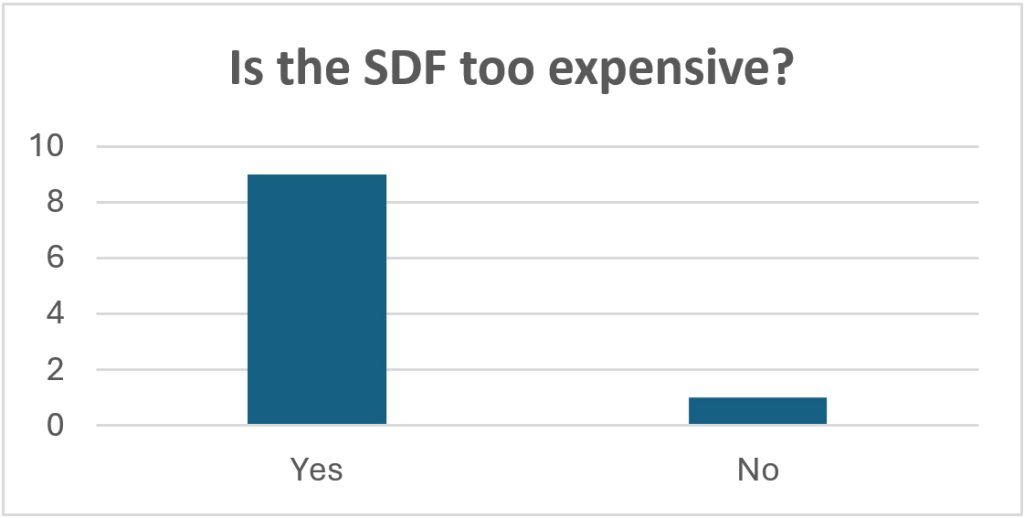
Figure 1:
9 out of 10 participants reported the SDF is too expensive and it is stopping people from coming to the country.
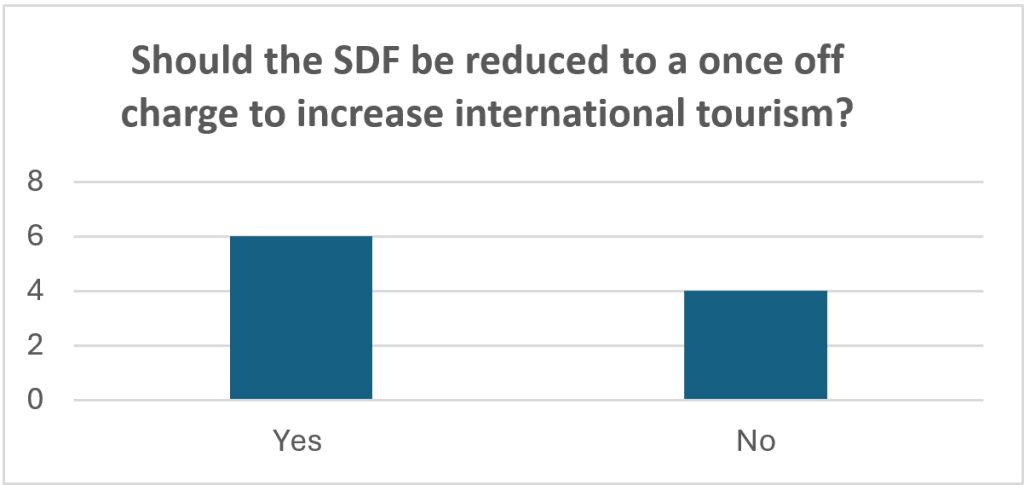
Figure 2:
From this question the following data was collected:
-6 out of 10 participants thought the SDF should be reduced to a one-off charge to increase international tourism for economic benefits.
-3 out of the 6 participants concurred the SDF should be a one-off payment of USD200.
-2 participants believed the SDF should come as a package, such as USD300 for 5 to 10 days or USD400 for 10 to 15 days.
-1 participant reported the SDF should be reduced to USD60-70 per day.
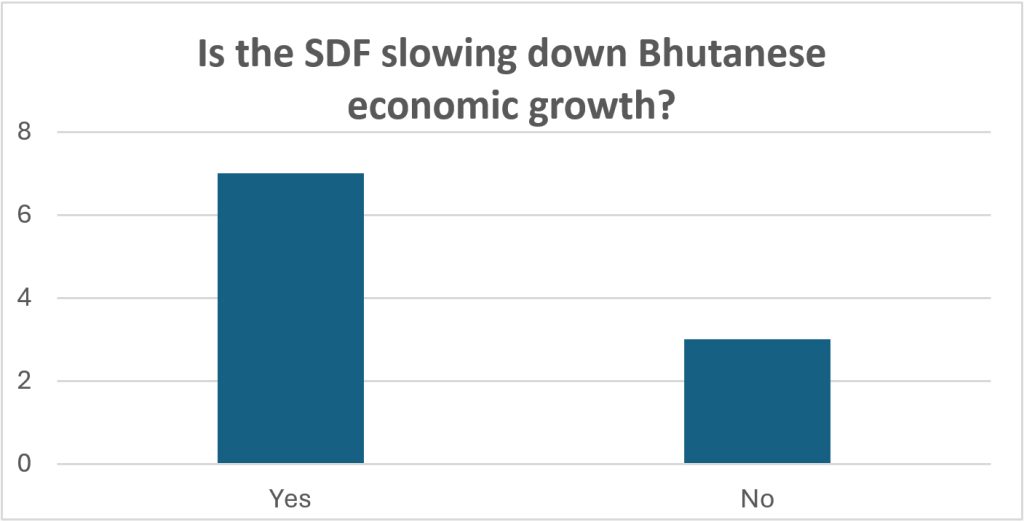
Figure 3:
7 out of 10 participants were worried the SDF is slowing down Bhutanese economic growth, especially for tourism related businesses such as hospitality, hotels, souvenir shops, tour guides and taxi drivers.
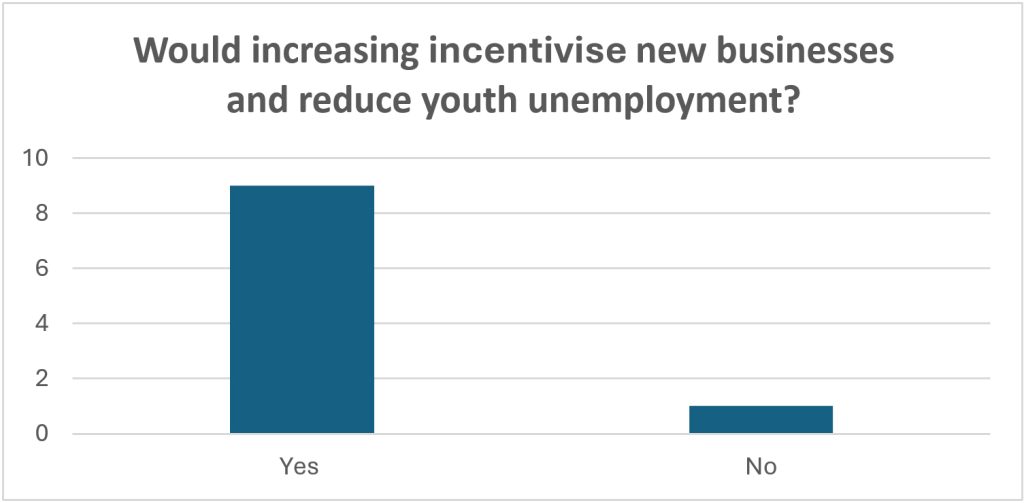
Figure 4:
9 out of 10 participants believed if the SDF was reduced, this would incentivise the youth to start more businesses in the tourism sector such as hospitality, hotels, souvenir shops, tour guides and taxi drivers.
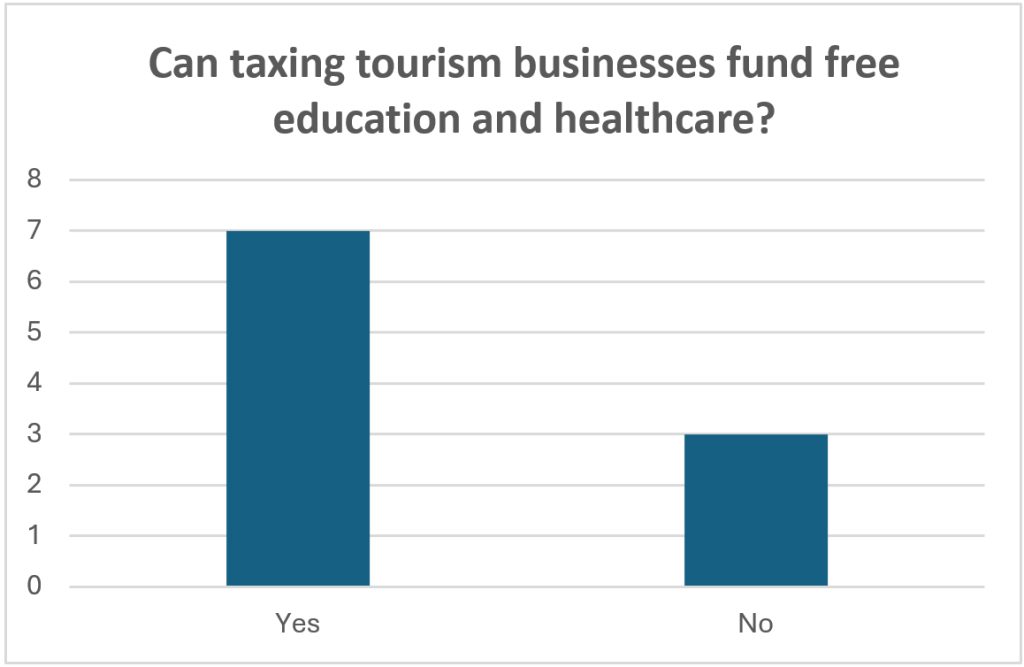
Figure 5:
7 out of 10 participants supported taxing tourism businesses to fund free education, healthcare and infrastructure development if the SDF is reduced to a once off charge.
All 10 participants were in favour of a fee of AU$7 to enter mountains, rivers, Dzongs and temples.
Discussion
Bhutan is a unique society which prioritises the Gross National Happiness Index (GNH) to balance citizen wellbeing such as health, happiness, environmental conservation, Buddhist cultural values and improved economic conditions. Alongside this distinctiveness, Bhutan has the SDF which is an unparalleled policy.
Having resided in Bhutan for 1 year, I have been so privileged to experience Bhutan’s rich cultural heritage and breathtaking landscapes. Sharing this once in a lifetime opportunity with family was the ultimate goal, but the SDF is unaffordable.
This research was intriguing since it revealed most participants favour reducing the SDF to stimulate economic growth. This solution sounds straightforward, however there are interconnected layers of complexity behind the SDF.
Delving deeper, it’s apparent the SDF is a stagnant policy only contributing some foreign currency and revenue. Inadvertently, the SDF is exacerbating population decline, since skilled Bhutanese are unable to build a career and are seeking favourable economic conditions abroad. Furthermore, Bhutan realised tourism cannot be the main economic driver, instead the country is prioritising economic development with the GMC.
It is admirable to witness Bhutan prioritise nature protection and the SDF aligns with the ecological modernisation theory where the policy has succeeded at protecting biodiversity in the mountains from soil degradation due to a lack of excessive foot traffic. Participants reported there is an overemphasis for Bhutan to prioritise environmental conservation which obstructs economic growth.
Hence, there is controversy over the Gross National Happiness Index (GNH), where the Bhutanese government claims to prioritise “Advancing Gross National Happiness for a peaceful, prosperous and sovereign Bhutan”. In reality, the GNH is misleading as several discussions in Bhutan reveal people are not truly happy due to a lack of career opportunities. This is evident with 9 out of 10 participants concurred the SDF has gone too far, is expensive and preventing people from coming to the country (Figure 1). 7 out of 10 participants reported the SDF is slowing down economic growth (Figure 3) with one business owner in the tourism sector reporting “My business is struggling to pay rent”. Furthermore, owners of souvenir shops lack the technological skills to sell their products via e-commerce (online websites) and are reliant on physical stores to attract customers.
Consequently, another perspective identified is the proposition to reduce the SDF to a once off charge of USD200 to incentivise international visitors and to rejuvenate the tourism industry. 6 out of 10 participants endorse reducing the SDF to a once off charge of USD200 or offering tourists a package such as paying a once off charge of USD300 for a 10-day stay, and USD400 for 15 days (Figure 2). Additionally, capacity development is a country’s political/economic power to balance between economic growth and environmental conservation. The notion of capacity development within Bhutan has shifted dramatically with mounting tensions on the Bhutanese government to promote rapid economic growth at the expense of environmental conservation.
Reducing the SDF is not a quick fix solution since Bhutan’s population remains low at 800,000 citizens, and it is economically unviable to rely on taxing a small population with low incomes to support these public services. If the SDF is reduced, there will be a surge in tourism, but Bhutan lacks infrastructure capacity such as roads, hospitality and airports to handle a higher percentage of tourists. Bhutan is recognised as the world’s first carbon negative country, but if the SDF was to be reduced, there will be a higher reliance on petrol for taxis and international flights. This will inevitably contribute towards rising carbon dioxide emissions. Electric car adoption is slow in Bhutan since the starting price of most vehicles is AU$20,000, and incomes are too low to justify this expense.
Within this research, there were 5 professionals and 5 laypersons. There were divided opinions where the laypersons were more in favour of boosting their earnings. In comparison, the professional participants were advocating for a more sophisticated Bhutanese economy which is not reliant on tourism for economic expansion.
On the one hand, the professionals favour reducing the SDF but are more hesitant to allow overtourism to ruin the country’s unique biodiversity. In the 13th five-year economic plan (2024-2029), the Bhutanese government is intending to invest in agriculture, tourism, hydropower and renewable energy. But the professional participants expressed concerns over Bhutan’s narrow economic reliance on subsistence agriculture, hydropower exports to India and tourism (SDF) and why the government is not immediately investing in new industries for economic expansion. The professional participants favoured the Gelephu Mindfulness City (GMC) project to enrich Bhutan. The GMC has significant economic potential to combine digital technology, artificial intelligence (AI) and maintaining a mindful balance between economic growth/environmental protection.
GMC is important but it is a long-term project that will not be fully completed for another 20 years. Consequently, the youth are demotivated, cannot see a future within their own country, and are still seeking economic opportunities abroad because they are unwilling to wait 2 decades for the GMC to be completed.
Conclusion
In conclusion, this research revealed reducing the SDF is not a straightforward solution. SDF is a source of revenue and a way to control numbers and Bhutan is unequipped and lacks infrastructure to handle a sudden influx of tourists if the SDF was reduced. The GMC appears hopeful for economic transformation, but project completion is decades away. Bhutan lacks alternatives to incentivise people to remain in the country and improve living standards. Consequently, reducing the SDF will not only assist Bhutan to balance its environmental conservation efforts with economic expansion but also reduce migration. Together with this it is recommended the core industries of the GMC should be implemented sooner rather than later for the whole of Bhutan to boost the economy and reverse the population decline.
Pascal Samfat is a New Colombo Plan scholar from Melbourne, Australia. He has completed study at the Royal Thimphu College and done internships at Tarayana Foundation and Innovate Bhutan. He can be contacted at pascalying18@gmail.com